On January 21, according to the official website of Tsinghua University, a team led by Ding Wenbo at the Tsinghua Shenzhen International Graduate School, in collaboration with multiple domestic and international institutions, has successfully developed a pigeon-eye-inspired multimodal high-resolution tactile sensor (SuperTac), marking significant progress in robotic tactile perception.
With the development of embodied intelligence technology, the scenarios of interaction between robots and humans are becoming increasingly rich, placing higher demands on robots' advanced tactile perception. However, current tactile sensing systems still lag significantly behind human touch in terms of spatial resolution, multidimensional perception, and signal interpretation capabilities. Visuotactile sensors achieve sub-millimeter resolution through imaging methods, but still face challenges in areas such as multispectral perception. Against this backdrop, how to break through the resolution limits of tactile sensors, enhance multimodal fusion capabilities, and achieve multimodal tactile signal interpretation has become a core scientific issue driving the development of "human-like touch" in robots.
It is understood that SuperTac innovatively combines multispectral imaging from the mid-infrared to ultraviolet bands with triboelectric signals, and features a multi-layer ultrathin sensing skin based on conductive polymers, a fluorescent layer, a reflective layer, and a support layer. SuperTac has force sensing range adjustment capability, achieving micron-level high resolution and multimodal high-precision measurement (force, position, temperature, proximity, vibration), and its sensing accuracy for information related to different physical properties such as material, texture, sliding, collision, and color all exceeds 94%.
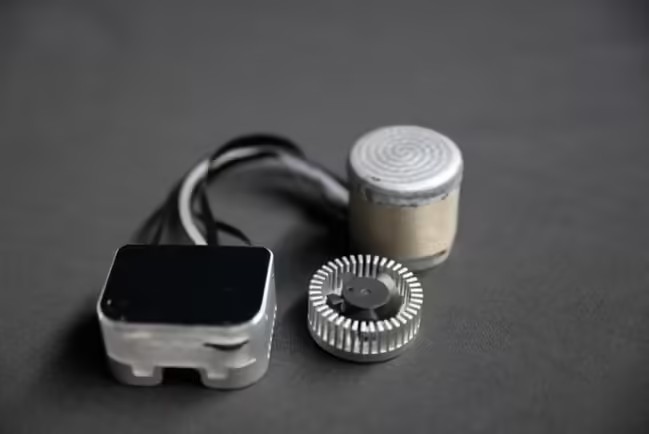
Sensor product photo
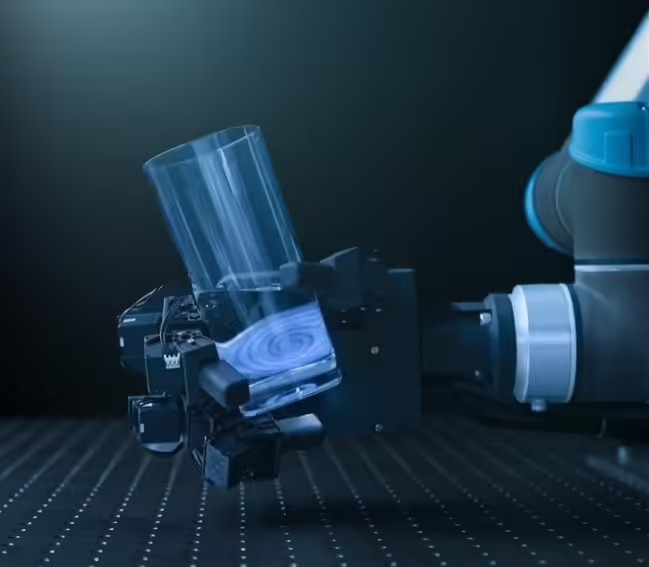
Install the SuperTac dexterous hand.
To fully unlock the sensor's multimodal perception potential, the team also independently built DOVE, a tactile language model with 850 million parameters. It can understand rich tactile information, giving robots human-like tactile perception and environmental understanding capabilities (Figure 4). Currently, SuperTac (Figure 5) has been successfully integrated into a robotic dexterous hand (Figure 6), supporting remote real-time status feedback, and is expected to play a transformative role in manufacturing, healthcare, service robotics, and other fields.

WeChat for technical support

PLUS Douyin