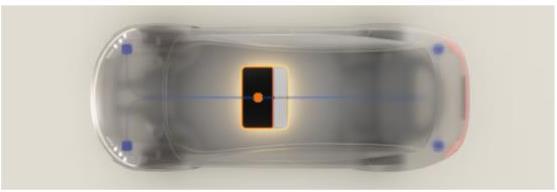
To achieve true differentiated competitiveness in software-defined vehicles (SDV), the first step is to build vehicle context—that is, to establish a real-time, comprehensive view of the vehicle. This requires breaking down information silos so that data and functions originally scattered across various functional domains can be accessed and operated at the vehicle level.
Current automotive architectures still widely adopt a siloed design: infotainment head units, autonomous driving systems, and core vehicle functions operate and are managed independently, each equipped with dedicated hardware and software stacks. This fragmentation limits innovation, as valuable data and functions remain trapped within their respective domains and zones. This leads to challenges such as rising complexity, increased costs, and slow integration of new features.
NXP's S32N7 ultra-integrated processor was born precisely to break down such barriers. By centralizing software and data across all vehicle domains, the S32N7 creates a unified vehicle context—enabling OEMs to expose, combine, and orchestrate data and functions, thereby unlocking new AI-driven capabilities. This architectural transformation not only significantly reduces complexity and cost, but also accelerates innovation, empowering automakers to deliver a new generation of intelligent vehicles with differentiated competitiveness.
Build smarter, move faster, unlock NXP technology, and pave the way for SDV development and production.
Vehicle Core Analysis: The Hub of a Modern Car
The core of the evolution toward software-defined vehicles lies in the intelligent vehicle core—this central computing platform orchestrates and manages all strategic vehicle functions, including body, motion, chassis control, gateway, vehicle connectivity, energy distribution, and even advanced driver assistance systems (ADAS).
Unlike infotainment systems that serve passengers or autonomous driving units focused on road conditions, the vehicle core is dedicated solely to the operation of the vehicle itself. By breaking through the limitations of traditional isolated ECU architectures, the vehicle core achieves functional integration and cross-domain data openness, creating a unified vehicle context capable of unlocking true innovation potential. This approach provides the flexibility to add new features, offers a direct channel to core vehicle data for advanced AI training and inference, and supports advanced computing capabilities such as integrated AI accelerators and high-performance application processing—none of which can be achieved in standalone ECUs.
This design can operate continuously for up to 15 years, ensuring stability, safety, and full lifecycle management. It forms the foundation of vehicles that are not only connected but truly cognitive. Delivering such a high level of intelligence requires immense computing power—something a fragmented architecture cannot provide. Only a unified vehicle core can meet the demanding data processing and performance requirements of AI-driven innovation.
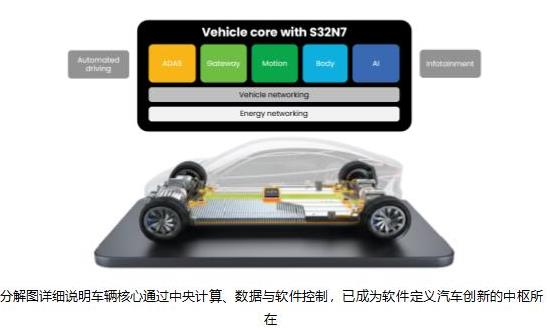
NXP S32N7 is purpose-built for the core of intelligent vehicles
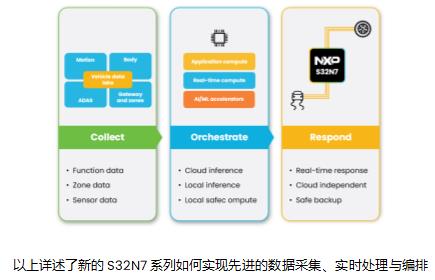
S32N7 delivers real-time control for safe execution, low-power operation, and fast boot, while introducing advanced features such as hardware-enforced consolidation, striking a balance between foundational functions and innovation. It consolidates up to eight traditional functional domains into secure software-defined partitions, creating a true vehicle context that enables seamless data sharing and cross-domain orchestration. This allows OEMs to develop entirely new data-driven and AI-driven functions, create differentiated services, and bridge the gap between established technological heritage and next-generation automotive innovation.
Confident innovation enables differentiated competitiveness. Learn how the S32N7 ultra-highly integrated processor transforms vehicles into intelligent edge devices.
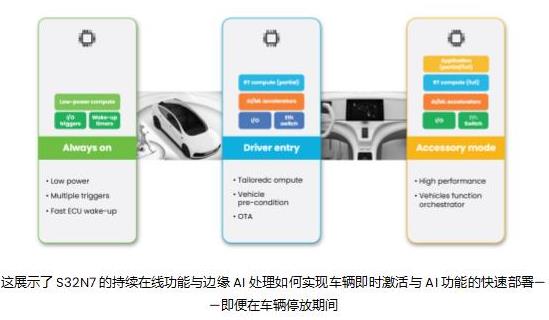
Hardware partitioning enables a modular architecture that reduces cost and simplifies design while aggregating data for deeper insights. Combined with ultra-low power (ULP) modes and fast startup, always-on intelligence keeps critical systems running and ready to support AI-driven services, even when the vehicle is idle.
The S32N7 is data-ready and AI-ready from the ground up, with built-in accelerators and PCIe expansion to handle continuously evolving workloads, along with future-proof adaptability. The S32N7 series enables OEMs to design the architecture once and deploy seamlessly across different vehicle models, market segments, and global regions without redesign.
Turn features into value
For automakers, the advantages of the S32N7 series include: lower total cost of ownership through ECU consolidation, more innovative vehicle core functions enabled by always-on AI, and full lifecycle control capabilities that support differentiated competitive advantages and create new revenue streams. Through central computing and edge AI deployment, S32N7 transforms the vehicle core into a strategic asset—improving current efficiency while opening up new possibilities for future business models.
• Ultra-high integration
The ultra-high integration of the S32N7 is fundamentally reshaping automotive architecture. Traditionally, body control, gateway, chassis, and motion control each required separate ECUs—every unit adding cost, wiring, and complexity. Now, a single chip can consolidate the functions of up to 8 ECUs. This centralization simplifies updates and upgrades: patches, bug fixes, and new features can all be delivered in one place, significantly reducing the risk of costly recalls and minimizing system downtime.
OEMs also gain scalable headroom for future features without having to redesign the system. By integrating multiple functions into a single SoC, the S32N7 can generate richer real-time vehicle data streams, unlocking AI insights and advanced services. For example, vehicle data can now be recorded and used to train new AI models based on real-world driving scenarios.
• Continuous online intelligence
Vehicles spend most of their time parked or charging, yet critical functions and services must continue running. The S32N7's always-on power mode enables predictive maintenance algorithms to operate continuously overnight, avoiding excessive battery drain without affecting the service life of other large subsystem SoCs. When the driver approaches the vehicle, personalized AI features such as air conditioning preconditioning, battery preconditioning, or smart access can be activated immediately. In addition, fast startup ensures these features respond instantly, delivering an exceptional user experience.
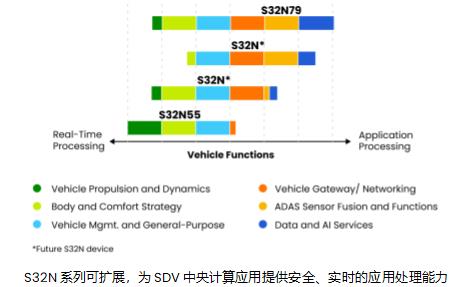
• Build once, scale comprehensively — no re-architecting required
OEMs aim to build once and scale across segments—not to create niche models. The S32N7 provides a unified platform spanning different segments and regions. Compatible SoC family products deliver the right performance while maintaining a unified architecture, and all models are managed through a unified software environment, greatly simplifying development and validation. With a modular design, automakers can flexibly add or remove features without redesigning the core compute unit, creating scalable vehicle scenarios that enable rapid differentiation across markets and models.
• Design data ready and AI ready
In the face of rapidly evolving workloads, hardware must evolve in step. Vehicles equipped with the S32N7 can connect to external AI accelerators via PCIe interfaces to support advanced control functions, while built-in accelerators handle real-time inference tasks involving safety and comfort features.
Application kernels and accelerators can extract, reformat, combine, and record data—enabling reuse of existing functions while adapting to new architectures. This data can be stored and post-processed specifically for training new AI models for core vehicle applications.
PCIe expansion not only enhances the vehicle's core AI capabilities but also boosts the performance of infotainment head units and ADAS subsystems. Through its future-ready architecture, the S32N7 can support new algorithms and evolving workloads without requiring a complete hardware refresh.

WeChat for technical support

PLUS Douyin