On January 29, it was reported that Chinese researchers published a paper in the journal Nature on January 28. Researchers from Tsinghua University, Peking University and other institutions successfully developed the FLEXI series of fully flexible digital compute-in-memory chips based on domestic processes, breaking through the inherent bottleneck of applying flexible electronics to edge high-performance artificial intelligence computing.
This chip is based on low-temperature polysilicon thin-film transistors. It is as thin as a cicada's wing, can be bent freely, and offers advantages such as ultra-low power consumption, high energy efficiency, and low cost.
The chip also adopts a "compute-in-memory" architecture built around all-digital static random-access memory, effectively merging the "memory unit" and the "computing unit" into one.
According to the official introduction from Tsinghua University, FLEXI is fabricated using a low-temperature polysilicon (LTPS) CMOS process, offering advantages such as being thin and lightweight, low cost, and high energy efficiency. The series includes three specifications: FLEXI-1 (1 kb), FLEXI-4 (4 kb), and FLEXI-32 (32 kb), integrating up to approximately 265,000 transistors and achieving a high level of integration of SRAM storage, computing units, and peripheral circuits on a single flexible substrate.
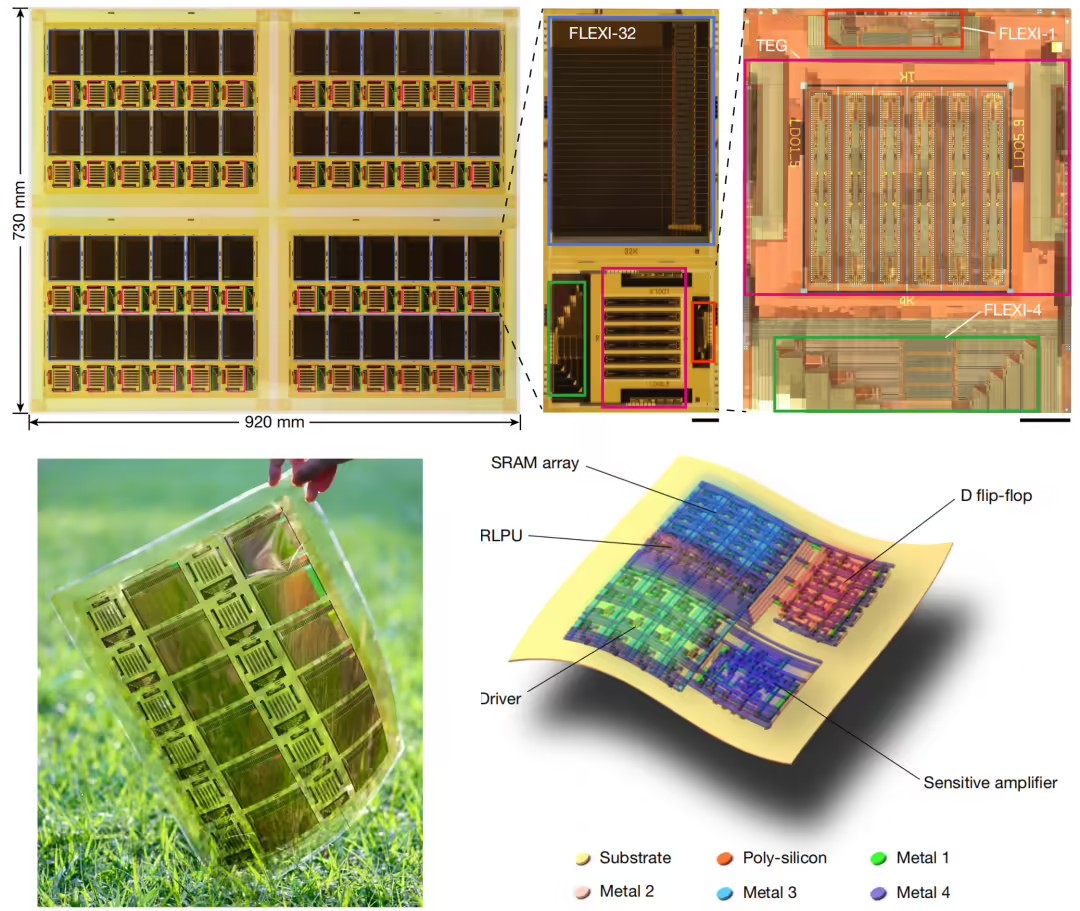
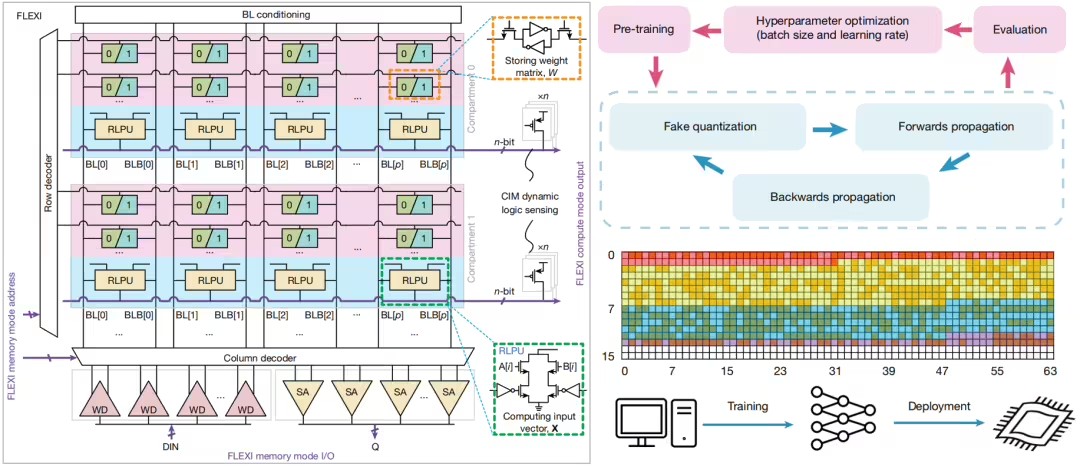
FLEXI adopts a modular, scalable digital compute-in-memory architecture, in which each module consists of 6T-SRAM cells and an embedded reconfigurable local processing unit (RLPU), supporting stable, high-speed, parallel dot-product operations. Through a cross-layer co-optimization (CLCO) strategy spanning manufacturing process, circuit design, and algorithm implementation, FLEXI maintains excellent computational accuracy, area efficiency, and energy efficiency under process variations and mechanical stress, while efficiently supporting single-instruction multiple-data (SIMD) operations in neural network inference.
To reduce the energy and time overhead caused by repeatedly writing neural network weights, the research team designed a set of lightweight neural network models for different chip capacities, enabling one-time on-chip deployment of weights. These models can efficiently process various data types such as ECG signals, speech, images, and multimodal physiological signals on the FLEXI chip, and can operate stably even on the smallest FLEXI-1 chip.
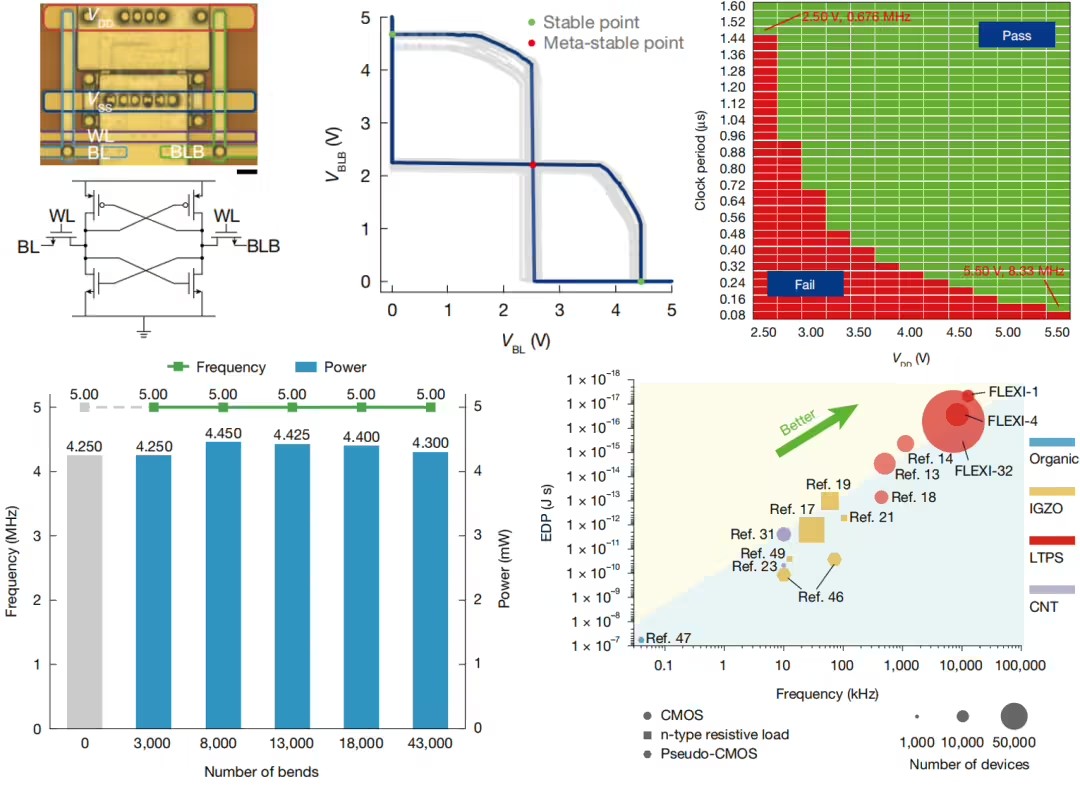
Experimental results show that the FLEXI chip can operate stably over a supply voltage range of 2.5–5.5 V and withstand more than 40,000 bending cycles under a 180° fold with a radius of 1 mm without significant performance degradation.
On FLEXI-1, the chip achieves a high-performance operating mode at 12.5 MHz and an ultra-low-power operating mode at 55.94 μW respectively.
At the same time, FLEXI achieves zero-error operation during long periods of high-frequency computation, with an overall yield of 70%–92%, a per-chip cost of less than 1 US dollar, and excellent long-term stability.
Compared with previously reported flexible computing chips, FLEXI achieves orders-of-magnitude improvements in both clock frequency and energy efficiency; compared with synchronous CPUs, its energy-delay product is reduced by 3–4 orders of magnitude. The combination of high performance, low power consumption, and excellent mechanical reliability makes FLEXI a highly promising flexible computing platform for edge artificial intelligence applications.
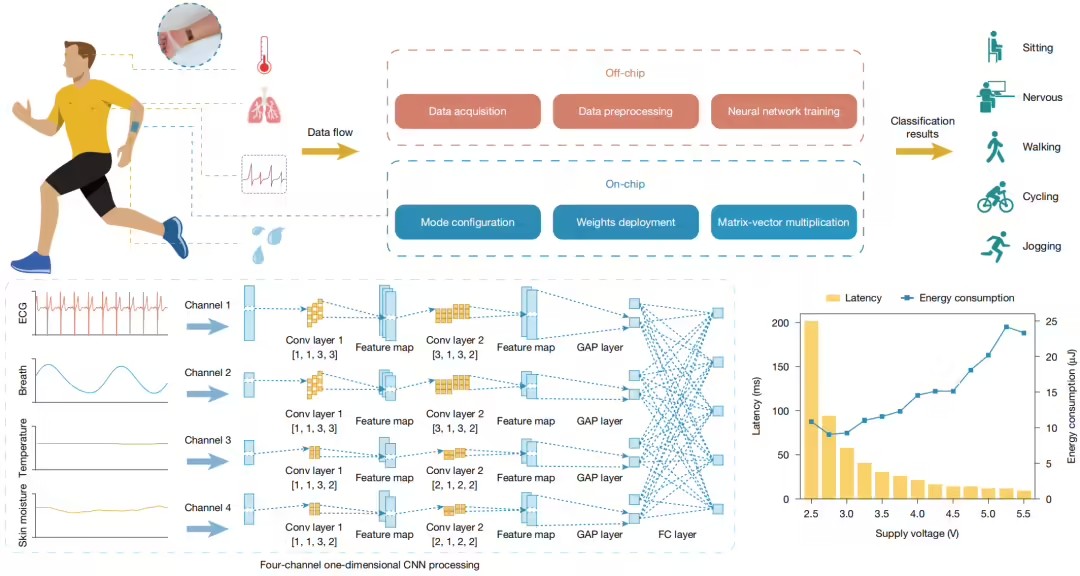
In terms of application validation, the research team used FLEXI for continuous monitoring and recognition of daily activities, demonstrating its application prospects in wearable health monitoring and multimodal in-sensor computing. The team collected multimodal physiological signals such as heart rate, respiratory rate, body temperature, and skin moisture from subjects under different states, built a lightweight four-channel convolutional neural network, and achieved one-time on-chip deployment on FLEXI-1. Through quantization-aware training, the model achieved a classification accuracy of 97.4% on the test set.
Overall, FLEXI is a flexible digital compute-in-memory chip based on LTPS-TFT technology. Through process-circuit-algorithm co-optimization, the chip maintains stable, error-free operation under high-frequency computation, extreme mechanical stress, and accelerated aging conditions, and demonstrates long-term stability exceeding 6 months. These results lay a solid foundation for the application of flexible electronic devices in mobile healthcare, embedded intelligence, and other edge computing scenarios.
Yan Anzhi, a 2021 doctoral student at the School of Integrated Circuits, Tsinghua University; Yan Jianlan, a 2021 master's student; Shen Penghui, a 2022 master's student; and Fu Yihan, a 2023 doctoral student at the School of Integrated Circuits, Peking University, are co-first authors of the paper. Professor Ren Tianling of the School of Integrated Circuits, Tsinghua University; Associate Researcher Liu Houfang of the National Information Center for Information Science and Technology, Tsinghua University; and Assistant Professor Yan Bonan of the Institute for Artificial Intelligence, Peking University, are co-corresponding authors. Associate Professor Yang Yi of the School of Integrated Circuits, Tsinghua University, and others are co-authors of the paper. Tsinghua University is the first affiliation of the paper. This research was supported by the National Natural Science Foundation of China, the Ministry of Science and Technology, the Beijing National Research Center for Information Science and Technology, and the Beijing Natural Science Foundation.

WeChat for technical support

PLUS Douyin