On January 28, according to news from the Optics Valley Laboratory today, the research team led by Tan Min from Huazhong University of Science and Technology and the Optics Valley Laboratory published a research paper in the top journal in the field of optical communications, the Journal of Lightwave Technology.
This study addresses the scalability challenges faced by large-scale optoelectronic fusion systems by proposing a novel Dissimilar Time-Division Multiplexing (DTDM) control architecture, and successfully develops China's first monolithic integrated optoelectronic fusion polarization and bias collaborative control chip based on the IHP 250nm BiCMOS process.
The research team proposed a general non-similar time-division multiplexing (DTDM) control architecture and completed tape-out verification based on the IHP 250nm BiCMOS optoelectronic monolithic integration platform.
The innovation of this architecture lies in the construction of a unified error-domain mapping mechanism, which normalizes feedback signals from different physical dimensions, such as the MZM bias voltage and polarization-state power, thereby enabling a single electronic controller to time-share a high-precision sensing front end, extremum-locking logic, and drive circuitry. Within millisecond-level time slices, the chip adaptively switches between bias control and polarization control tasks, achieving for the first time monolithic coordinated regulation of heterogeneous optical devices.
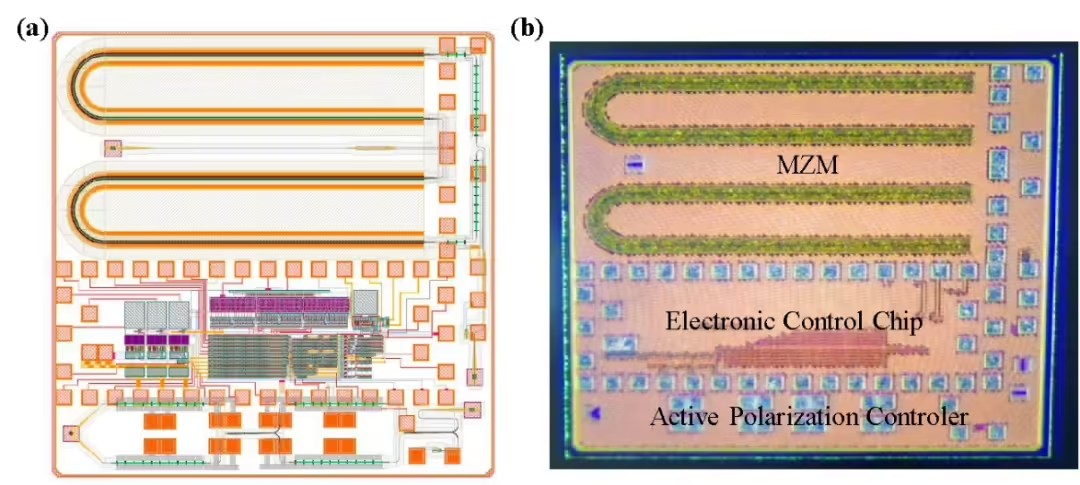
▲ Optoelectronic Fusion Fully Integrated Polarization and Bias Collaborative Control Chip
Thanks to innovation at the architectural level, the chip achieves high-performance closed-loop control with minimal hardware resources. The key technical specifications are as follows:
Resource efficiency is significantly improved: compared with traditional parallel control schemes, the DTDM architecture achieves 44.4% chip area savings and 23% power consumption reduction, with the core control circuit area being only 0.255 mm² and total power consumption as low as 2.988 mW.
High-precision bias/polarization dual locking: In bias control mode, it achieves a linear control range of 0.7 rad and a tracking bandwidth of 5 Hz, effectively suppressing thermal crosstalk; in polarization control mode, it achieves an extinction ratio (ER) of up to 34 dB, with polarization state tracking resolution better than 0.01 rad/s.
High-speed link transmission capability: The measured results show that with coordinated control enabled, the system supports single-mode transmission of 100 Gbps NRZ signals; even under the complex scenario where both bias and polarization dual closed-loop control operate simultaneously, stable error-free transmission of 56 Gbps NRZ is still achieved, with a clearly open eye diagram.
The Optoelectronics Laboratory stated that this work not only developed China's first optoelectronic fusion fully integrated polarization and bias collaborative control chip, but also provided a highly scalable general architecture path for the low-power design of future ultra-large-scale, heterogeneous optoelectronic integration systems.
Chen Jimin and Wang Yuhang, PhD students from the School of Integrated Circuits at Huazhong University of Science and Technology, are co-first authors of the paper, and Tan Min, a dual-appointed researcher at Huazhong University of Science and Technology and the Optics Valley Laboratory, is the corresponding author. This work was supported by the National Key Research and Development Program (2024YFB2807601) and the Optics Valley Laboratory Proof-of-Concept Project (OVL2025YZ003).

WeChat for technical support

PLUS Douyin