For those in the air tightness testing industry, the IP67/68/69 waterproof rating standards are quite familiar. If a manufacturer wants its products to meet these waterproof rating requirements, how can it use a more efficient air tightness tester for testing? What conversion relationships are involved?
IP (Ingress Protection) rating is an international standard used to define the ability of electronic devices to resist the ingress of solid particles and liquids. An IP rating consists of two digits. The first digit indicates the level of protection against solid particles, ranging from 0 to 6, with a higher number indicating greater protection. The second digit indicates the level of protection against liquids, ranging from 0 to 8, with a higher number indicating greater protection. IP ratings are commonly used for consumer electronic products, such as smartphones, outdoor speakers, and underwater cameras, to indicate their usability in wet or dusty environments. However, it should be noted that an IP rating does not mean that a device can withstand underwater pressure indefinitely. Particularly in higher-level waterproof tests, the test conditions (such as water depth and duration) should be applied within the range recommended by the manufacturer.
The IP rating is IP67. Devices that meet this rating are considered dust-tight and can be immersed in water at a depth of 1 meter for 30 minutes. The IP67 standard specifies a water depth of 1 m (approximately 10 kPa). Generally, manufacturers increase the pressure and conduct the waterproof test at a pressure of 15-20 kPa.
The standard pressure decay for air tightness testing is within 30 Pa/1 sccm. A leak in air tightness testing within 30 Pa meets the normal standard, so it is generally within 30 Pa. (Different products have different test pressures and test times, so the pressure decay values will vary. If the difference between qualified and unqualified products is beyond 30 Pa, they can be distinguished very easily.)
Ideal Gas Law. We know that pressure, volume, and temperature are all related in a closed system. If the temperature of the part changes during the test, the pressure inside the part will also change.
Because of the linear relationship between flow and pressure—the higher the pressure, the greater the likelihood of passing through the leak location—we can directly correlate the water flow rate under pressure with the air flow rate under pressure.
1 meter of water equals 1.44 psig of water pressure.
10 meters of water equals 14.4 psig of water pressure
These pressures will be used to determine the leak test for the IP67 rating.
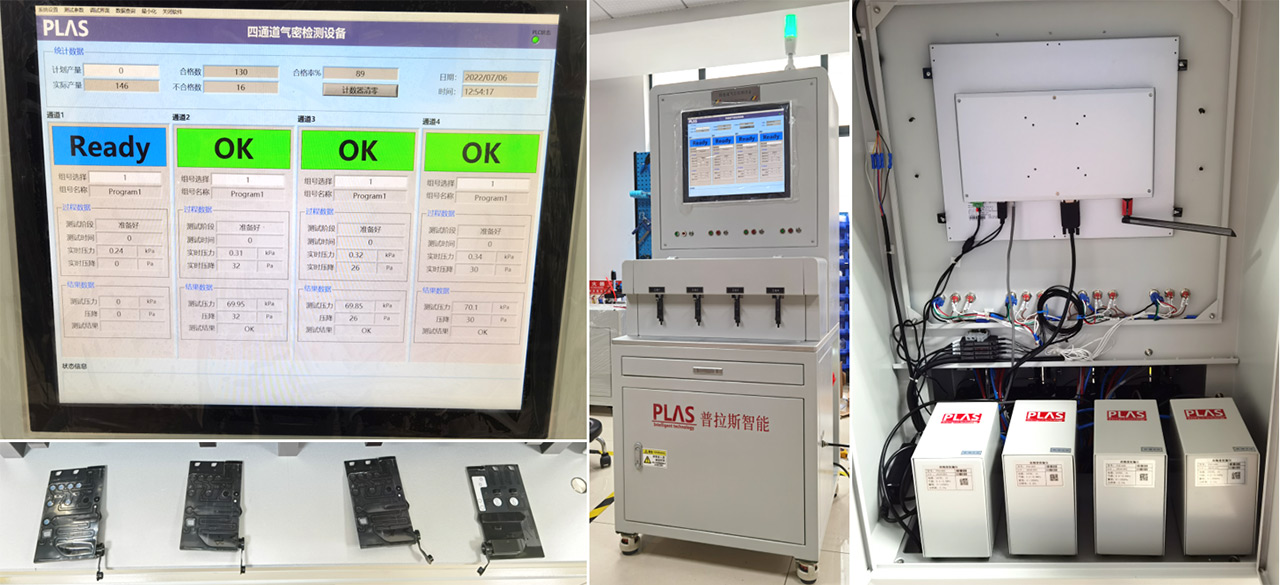
PLUS (Guangzhou) Intelligent Technology Co., Ltd.With extensive leak testing experience, we can provide reasonable recommendations on test requirements, test time, and test standards based on the characteristics of your products, and can also providePrototype air tightness testers, product testing services, custom non-standard air tightness testing equipment, etc.

WeChat for technical support

PLUS Douyin