After the typhoon passed, rainwater still clung to the surface of the equipment cabin at the coastal energy storage station, yet the lithium battery modules inside remained as dry as new—behind this lies the "invisible barrier" for the safe operation of energy storage cabinets, and it depends on the rigorous protection of the energy storage cabinet sealing test line. Today, as the energy storage industry accelerates its penetration, sealing performance has become one of the core indicators determining the reliability of energy storage systems, and an efficient and precise sealing test line is precisely the key to ensuring that energy storage equipment is "safe from wind and rain."
The sealing performance of energy storage cabinets is never a "minor issue." In outdoor application scenarios, environmental factors such as high temperature and humidity, heavy rain and dust, and salt spray corrosion constantly threaten equipment safety. Once the seal fails, water vapor infiltration can cause lithium battery short circuits and fires, dust accumulation may lead to component wear, and salt spray erosion will accelerate the corrosion of metal structures. These hidden dangers not only cause millions in equipment losses but may also trigger safety accidents. An energy storage project once suffered from poor container sealing, resulting in condensation inside the cabin during the plum rain season, which led to decreased consistency of the battery pack and directly shortened its service life by 30%. This is precisely why more and more companies in the industry regard sealing testing as a "mandatory test" before energy storage cabinets leave the factory.
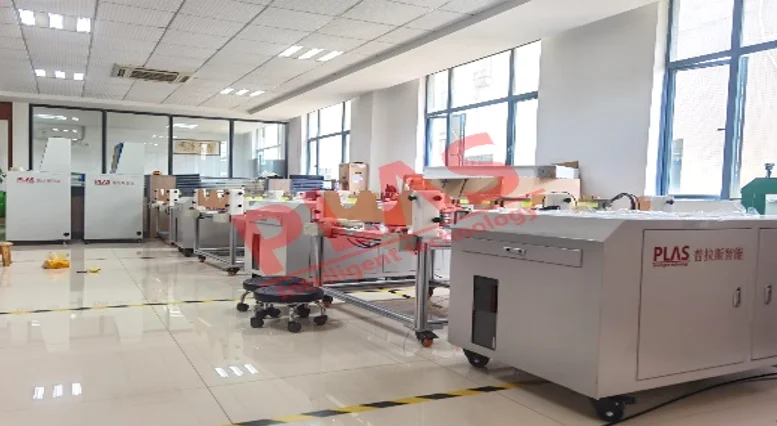
Compared with traditional testing methods such as manual water pouring and pressure gauge readings, modern energy storage cabinet sealing test lines have achieved a qualitative leap from "experience-based judgment" to "data-driven decisions." Taking the fully automated test line of a new energy equipment manufacturer as an example, the entire production line integrates the full process of loading and transfer, sealing chamber clamping, multi-point testing, and data traceability. Only 2 operators are required to complete a full day of testing work, and testing efficiency is more than 5 times higher than manual operation.
The "hardcore strength" of the testing line is first reflected in its detection accuracy. The testing unit, which uses helium mass spectrometer leak detection technology, can accurately capture leaks at the level of 1×10⁻⁹ Pa·m³/s—equivalent to precisely identifying a gap just 1/100 the thickness of a hair even within a space the size of a basketball. During testing, the energy storage tank is placed inside a sealed test chamber, and helium at a specific concentration is injected into the tank through a dedicated interface. The leak detector then monitors changes in helium concentration inside the chamber in real time. The entire process is fully automated, eliminating errors caused by manual operation, and the pass rate remains stable at 99.8%.
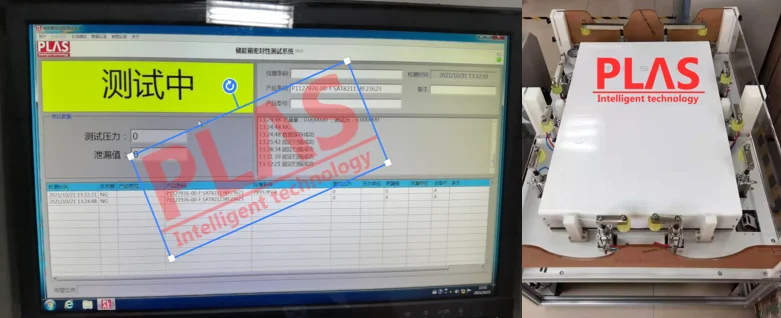
Intelligent control is another highlight of the test line. Each test line is equipped with a dedicated MES system. From the moment an energy storage cabinet enters the test line, information such as its model, batch, test time, and inspection data is automatically collected and uploaded to the cloud. Operators can view the test curves in real time through the central control screen. Once a leak exceeds the limit, the system immediately triggers an audible and visual alarm and precisely locates the leak point. This data not only provides a basis for product quality traceability, but also supports the structural optimization of energy storage cabinets through big data analysis. One company analyzed over 100,000 data sets accumulated from its test line and found that a certain model of energy storage cabinet had a high leak rate at the sealing strip joint. After improving the sealing structure accordingly, the incidence of this problem dropped by 90%.
For energy storage needs in different scenarios, the test line also offers a high degree of flexible adaptability. Whether it is a 10-foot small energy storage cabinet or a 40-foot containerized energy storage system, precise testing can be achieved by quickly adjusting the test chamber dimensions and replacing dedicated sealing connectors. For energy storage projects in extremely cold regions, the test line can also simulate a -40°C low-temperature environment to test the shrinkage performance of sealing materials under extreme temperatures; while for the needs of coastal regions, a salt spray test module can verify the corrosion resistance of the sealing structure.
Guided by the "dual carbon" goals, the energy storage industry is experiencing explosive growth, and the energy storage cabinet sealing test line is a critical link in shoring up the industry's safety bottom line. A senior executive of a leading energy storage company stated that since the introduction of the fully automated sealing test line, its after-sales failure rate has dropped by 65%, and its competitiveness in overseas markets has improved significantly. Behind this lies the test line's relentless pursuit of every sealing detail, and moreover, the practice of the "safe energy storage" philosophy.
From precision instruments in the laboratory to automated production lines in factories, the upgrading of sealing test technology bears witness to the transformation of the energy storage industry from "rapid growth" to "high-quality development." In the future, with the rise of new energy storage technologies such as hydrogen energy storage and flow batteries, sealing test lines will face even greater challenges—for example, leak detection for high-pressure hydrogen storage tanks, or special sealing test requirements adapted to extreme operating conditions. But one thing is certain: this "lifeline" that safeguards energy storage safety will always stand at the forefront of technological innovation, protecting the healthy development of the energy storage industry.
If you are also concerned about the safety performance of energy storage equipment, you are welcome to leave a comment and discuss innovative applications of sealing test technology, so that together we can drive the energy storage industry toward a safer and more reliable future!
The test line includes three sets of leak testing systems,3Set of air tightness test fixtures, as well as2Set of data acquisition systems, each fixture is equipped with two scanners, test results correspond one-to-one with product QR codes, and data is uploaded.MESSystem, with an intelligent dashboard.

WeChat for technical support

PLUS Douyin