As one of the excellent quality inspection tools, the air leak tester plays a very important role in the manufacturing field.
So what exactly is an air tightness leak detector? What features does it have? And how is it applied across major industries?
Simply put, an air tightness leak detector is a tool that uses "pressure difference" to detect whether there is a leak between the inside and outside of an object.
It can perform surface or internal leak defect testing on objects and quantitatively calculate the leak rate.
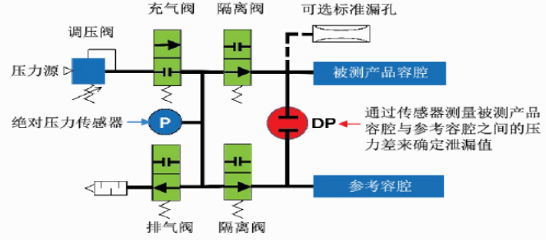
Many mechanical devices and vehicles must maintain good air tightness, such as automobile tires, fuel containers, engine and aircraft hydraulic lines, and fuel tanks. During production, it is essential to ensure they have no leakage issues whatsoever. Such problems can lead to very serious or even catastrophic consequences in normal use.
Therefore, it has become particularly important to use high-precision, efficient, fast, and accurate testing to detect surface or internal leak defects in objects.
The air tightness leak detector features simple operation, fast testing speed, and accurate test results.
It can achieve high precision, high sensitivity, and broad applicability according to the different requirements of the object under test.
At the same time, various types of air tightness testing methods, such as mass flow method, differential pressure method, vacuum degree method, and negative pressure leak testing method, have been widely applied across major industries.
An air tightness leak detector is an instrument specifically designed to test the air tightness performance of a product or system. It applies a certain pressure to the product or system under test and determines its air tightness performance by observing pressure changes or gas flow conditions.
The basic principle of an air tightness leak detector is a pressure-change-based air tightness testing method. It applies a certain pressure to the product or system under test and observes the pressure change to determine its air tightness performance. Common principles of air tightness leak detectors include the pressure loss method, the differential pressure method, and the pressure holding method.
In the pressure decay method, the air tightness tester applies gas pressure to the product or system under test and observes the pressure change after a period of time. If the pressure change is very small or there is no change, the product or system has good air tightness performance. If the pressure drops rapidly, there is a leak problem.
In the differential pressure method, the air tightness tester applies different pressures to both sides of the product or system under test and monitors changes in the pressure difference. If the pressure difference remains stable, the product or system has good air tightness performance. If the pressure difference drops rapidly, a leak is present.
In the pressure hold method, the air tightness tester applies gas pressure to the product or system under test and observes the pressure change after a period of time. If the pressure remains stable, the product or system has good air tightness. If the pressure drops rapidly, a leak is present.
Air tightness leak detectors are widely used across various industries and fields, such as automotive manufacturing, aerospace, and electronic equipment. They can be used to test the air tightness performance of automotive engine cylinders, piping systems, seals, valves, and more. In the aerospace field, air tightness leak detectors can be used to test aircraft fuel systems, pneumatic systems, cabin door seals, and more. In the electronic equipment field, air tightness leak detectors can be used to test the air tightness performance of electronic components, batteries, circuit boards, and more.
As the technical level and quality requirements in the production field continue to rise, the importance of the air tightness tester as a tool has become increasingly prominent in production where air tightness is used as a key indicator for evaluating and monitoring products. Mastering its basic principles and application methods can help enterprises complete various important tasks more accurately and efficiently, and push them to a more competitive position in the market.

WeChat for technical support

PLUS Douyin