With the continuous advancement of modern industrial technology,Air tightness testingAs a necessary technical means, it has played an increasingly important role in the manufacturing process. The air tightness leak detector is one of the indispensable components.
Air tightness testing is a technology used to test the air tightness performance of an object or system. By measuring changes in the internal pressure of the object or system, it determines whether there are leaks or poor sealing issues.
The principle of air tightness testing is based on the diffusion of gas molecules and pressure transmission. When a closed system has a leak or poor sealing, the gas inside the system escapes through the leak or the poorly sealed area, causing a change in the internal pressure of the system. By measuring the change in the internal pressure of the system, it can be determined whether the air tightness performance of the system meets the requirements.
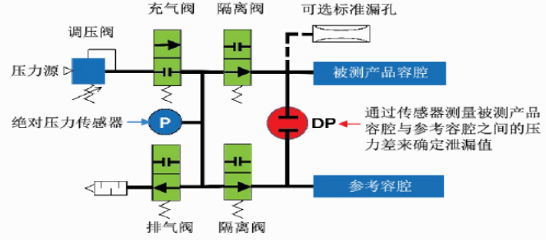
According to the different methods and technologies of air tightness testing, air tightness testing can be classified into the following categories:
1. Air tightness testing based on pressure change: This method determines air tightness performance by measuring changes in pressure within the system. Common methods include the pressure loss method, differential pressure method, and pressure change rate method.
2. Air tightness testing based on leakage flow rate: This method determines air tightness performance by measuring the gas flow rate through the leak opening. Common methods include the mass spectrometry method, the capillary method, and the leakage flow meter method, among others.
3. Gas concentration-based air tightness testing: This method determines air tightness performance by measuring changes in gas concentration within the system. Common methods include the gas detector method and the gas analysis method.
4. Gas tracer-based air tightness testing: This method determines air tightness performance by injecting a tracer gas into the system and then measuring the concentration of the tracer gas or the leak rate within the system. Common methods include helium leak detection and gas tracer methods.
In summary, air tightness testing is a technique that determines air tightness performance by measuring changes in parameters such as internal pressure, leak flow rate, gas concentration, or gas tracing within an object or system. Based on different methods and technologies, air tightness testing can be classified into categories such as pressure change-based, leak flow rate-based, gas concentration-based, and gas tracing-based.
CurrentlyAir tightness leak detectorIt has been widely used in many fields, including the automotive industry, electronics industry, aerospace industry, and medical device industry. In automotive manufacturing, for example, air tightness testing is an indispensable step in the assembly of components such as engines, brake systems, air conditioning systems, and tires. In the electronics industry, especially in the production and testing of semiconductor chips, strict air tightness testing is also required.

WeChat for technical support

PLUS Douyin