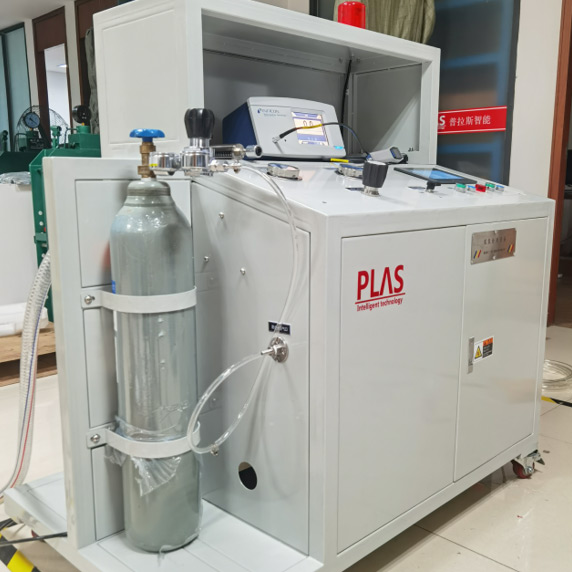
In modern industrial production, even minor leaks in most equipment can lead to serious consequences, especially in working environments that demand high precision, high efficiency, and safe operation. Against this backdrop, the hydrogen-nitrogen leak detector has become a reliable assistant for enterprises to ensure stable and safe equipment operation.
A hydrogen-nitrogen leak detector is a leak testing device that uses a hydrogen-nitrogen gas mixture (typically 5% hydrogen and 95% nitrogen) as a tracer gas. The hydrogen-nitrogen leak detector is a high-precision gas leak detection device, mainly used to detect leaks in equipment and products. It adopts the most advanced sensor technology and digital processing technology, and can accurately detect tiny gas leaks and display the leak location and leak rate in real time.
This leak detector offers multiple advantages. First, it features high sensitivity and fast response capability, enabling timely detection and alarming of gas leaks. Second, it provides powerful data processing and storage functions, allowing it to record and analyze leak data, offering strong support for subsequent troubleshooting and equipment maintenance. Finally, its portable design allows operators to easily perform testing at different locations, greatly improving work efficiency.
Hydrogen-nitrogen leak detectors are indispensable testing tools in modern industrial production. Their high precision, high efficiency, automation, and intelligent features can greatly improve equipment reliability and safety while reducing the cost and risk of industrial production. If you are looking for an efficient and reliable leak testing solution, this type of leak testing equipment will be your best choice.
The testing steps for a hydrogen-nitrogen leak detector are as follows:
Test calibration: Before starting the test, the hydrogen-nitrogen leak detector must be calibrated to ensure the accuracy of the test results.
Preparation: Introduce the hydrogen-nitrogen mixture into the system under test and record the initial leak rate.
Testing phase: pressurize the system to a specified pressure and observe the pressure change. If the pressure drops, a leak is present.
Data analysis: Through the data analysis function of the hydrogen-nitrogen leak detector, the leak location andLeak rate。
End of test: After the test is completed, the remaining hydrogen-nitrogen mixture needs to be vented, and the system must be cleaned and restored.

WeChat for technical support

PLUS Douyin