Application of the CTS A28 Differential Pressure Leak Detector in Headlamp Sealing Tests

PLUS (Guangzhou) Intelligent Technology Co., Ltd. | CTS Sentinel A28 differential pressure leak detector · 100% in-line inspection for Automotive LED Headlight Assembly Sealing Test · master-part comparison · 32 test programs · traceable data
LED headlight sealing test headlight assembly air tightness test differential pressure leak detector CTS A28 headlight fogging test headlight waterproof test

One-sentence answer: An LED headlamp assembly is formed by bonding or hot-melt welding the lens to the housing, and internally it is divided into multiple optical cavities and a driver cavity. A broken adhesive bead or a poorly sealed wire harness outlet will allow water ingress and fogging, which in turn shorts out the LED driver board. Using the CTS Sentinel A28 differential pressure leak detector to compare a master part against the part under test maintains stable judgment on large-volume assemblies with breathable membranes such as headlamps.
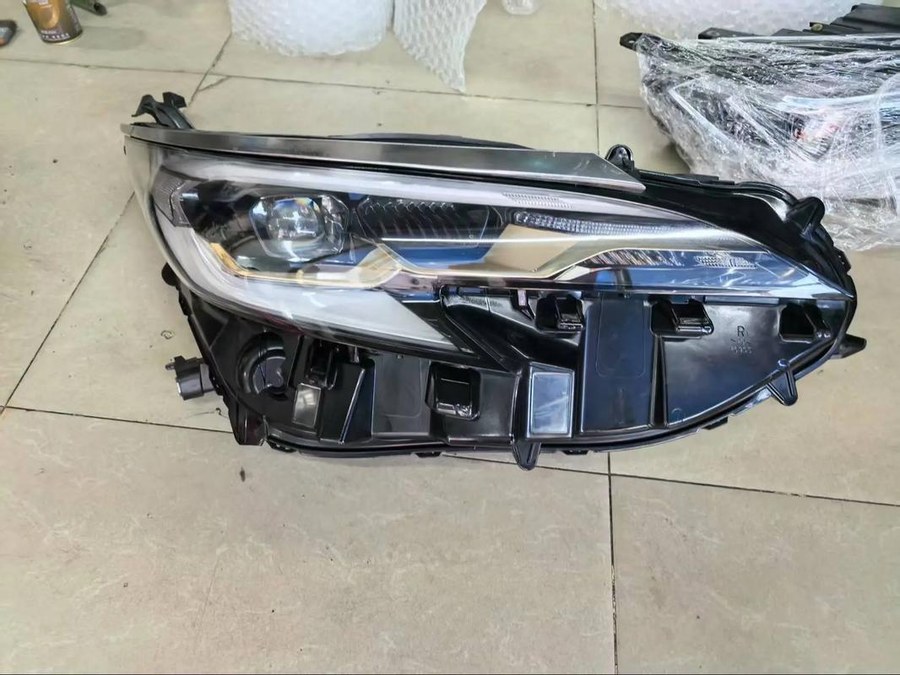
Automotive LED headlight assembly
Sealing and fogging control for LED headlight assemblies

Lens and housing are bonded or hot-plate welded: a broken adhesive bead or a poorly sealed wire outlet causes water ingress and fogging

01

I. Industry Pain Points: Four Special Characteristics of Headlamp Assembly Testing

1The adhesive bead between the lens and the housing is a long, curved closed line.

Hot-melt adhesive or structural adhesive is applied along the entire perimeter, and broken beads, insufficient bead width and bubbles can all occur. Once covered by the lens they are completely invisible, and only pressure testing can expose them.

2The assembly has a large volume and many buffer cavities.

The interior of a headlamp is divided by styling into multiple chambers for high beam, low beam, turn signal and driver board. The total volume is far larger than that of a compact part with the same external dimensions, so fill and stabilization times are significantly longer.

3The breathable membrane causes a controllable slow pressure release.

For anti-fogging and pressure equalization, headlamps are usually fitted with a breathable membrane. During pressure testing the membrane itself causes the cavity pressure to change slowly and continuously. If this is not handled, it is easily misjudged as a leaking part.

4Fogging inside the lamp is the most common appearance complaint.

Even if the leak is extremely small, as long as water vapor can enter, the lamp will fog and accumulate water under temperature differences. OEMs will directly judge it as nonconforming, and it affects vehicle performance and reputation.

02

II. Test Object and Failure Risks

Sealing pointsMain failure surfaces and leakage consequences

Sealing locations:

  • The perimeter adhesive bead between the lens and the housing (the main failure surface);
  • The sealing of the wire harness outlet and the lamp body connector socket (potting or sealing ring);
  • Through-holes for accessories such as the leveling motor and the breathable membrane seat.

Consequences of leakage: water vapor enters the lamp cavity, the LED driver board shorts out and is damaged, and the reflective surface coating deteriorates from moisture. The lamp fogs and accumulates water under temperature difference conditions, light distribution performance drops, and this directly violates the vehicle lamp performance requirements.

03

III. Test Solution: Why Choose the CTS A28

A28 solutionHow differential pressure comparison solves this testing challenge

The headlamp assembly is a large-volume, multi-cavity workpiece with a breathable membrane. The difficulty in judgment lies in distinguishing a true leak from the slow pressure release of the membrane:

  • Differential pressure comparison structure: The A28 adds a differential pressure decay circuit and a differential pressure sensor on top of direct pressure. The master part and the part under test are pressurized simultaneously, and the differential pressure between them is read directly. Ambient temperature fluctuations act on both workpieces in approximately the same way and cancel each other out in the differential pressure channel, so the reading is stable.
  • Short-window judgment combined with the breathable membrane: Because the criterion comes from the relative differential pressure of the two workpieces, under conditions where the breathable membrane causes a slow pressure release, a shorter time window can still distinguish a true leak. This is difficult to achieve with a single-channel direct pressure method.
  • Multiple test programs and production line integration: The A28 is a single-channel wall-mounted model that can store 32 test programs, with programs created separately by lamp model and cavity. Digital I/O drives the fixture cylinders and the pass/fail sorting, and data can be stored and uploaded to MES.
04

IV. Test Process and Key Points

ProcessFrom plugging and stabilization to sorting and data retention

  1. 1Plugging: Use custom-formed fixtures to plug the wire harness outlet and accessory through-holes. The plugging surface around the lens perimeter must conform to the adhesive bead contour to avoid crushing the lens edge.
  2. 2Breathable membrane handling: Depending on the process, either temporarily plug the breathable membrane seat, or use a shortened time window and dedicated limits to offset the membrane pressure release. Both methods must be fixed in the test program.
  3. 3Fill and stabilization: Fill with dry compressed air and wait for pressure stabilization according to the assembly volume.
  4. 4Test and sorting: Enter the differential pressure test stage and compare the differential pressure change between the lamp cavity (after plugging the lens perimeter adhesive bead and the wire harness outlet) and the master part, then complete sorting according to the I/O output.
  5. 5Data retention: Results are stored by lamp serial number and uploaded to MES.
Key points: The plugging fixture for the headlamp assembly should be designed for custom-formed fit, to avoid pressing only the housing edge and causing the lens to crack under stress. The master part should preferably be a dormant part with the same structure as the production part, and should be rechecked regularly.
05

V. FAQ

Q1The headlamp has a breathable membrane. Can pressure testing still be performed?

Yes. The breathable membrane causes a controllable slow pressure release, and there are two ways to handle it: first, temporarily plug the breathable membrane seat with a plug during testing; second, shorten the test time window to a range where the membrane pressure release effect is negligible. Both methods must be confirmed with the accessory supplier and written into the test program, to avoid judging the normal pressure release of the breathable membrane as a leak.

Q2The headlamp assembly has multiple cavities. Does testing need to be done cavity by cavity?

It depends on the structure. If the cavities are connected through structural holes, the whole assembly can be tested as one cavity. If the driver cavity and the optical cavity are sealed off from each other, they should be plugged and judged separately, because their failure consequences and judgment limits are different. The multiple test programs of the A28 can cover both approaches.

Q3After a leak is detected, how do you find the specific leak point?

First use sectional plugging to narrow the range down to one segment among the adhesive bead, the wire harness outlet or the accessory through-holes, then apply soap solution to the suspect area or immerse it in water to observe bubbles. After locating it, the position should be fed back to the adhesive application or assembly process and corrected through process parameters, rather than relying on rework and re-gluing as a fallback.

06

VI. Conclusion

In sealing tests of LED headlamp assemblies, true adhesive bead and through-hole defects must be identified while a breathable membrane is present. The differential pressure comparison structure of the CTS Sentinel A28 supports stable judgment in a short time window, and together with custom-formed fixtures and 32 test programs, it is suitable for 100% inspection of multiple assembly models in volume at automotive lighting plants.

07

PLUS — CTS A28 Differential Pressure Leak Detector and Sealing Test Solutions

PLUS (Guangzhou) Intelligent Technology Co., Ltd. was founded in 2018 and specializes in sealing and leak testing. It is a National High-Tech Enterprise (Certificate No.: GR202244005066) and has passed ISO 9001 quality management system certification. The company integrates technology development, production and sales, delivering high-precision air tightness testing solutions for new energy drive systems, automotive components, home appliances and general industry — including leak detector selection, custom plugging fixtures, production line integration, installation and commissioning, and personnel training.
Why differential pressure: the CTS Sentinel A28 pressurizes a master part and the part under test at the same time and reads the differential pressure between them directly. Ambient temperature drift affects both parts in nearly the same way and cancels out in the differential pressure channel, so readings are more stable than single-channel direct pressure — ideal for thin-walled parts, plastic parts and larger cavities.

CTS Sentinel A28 Differential Pressure Leak Detector

  • Differential pressure comparison, reads the difference between master part and part under test
  • Single-channel wall-mounted model with 32 storable test programs
  • Built-in calibrated leak, supports automatic calibration and self-test
  • Digital I/O drives fixture cylinders and stack light for accept/reject sorting

CTS I28 Multi-Function Single-Station Model

  • Combines several test methods in one instrument
  • Suited to large-volume cavities and multi-process testing
  • Results stored by serial number and uploadable to MES

CTS C28 Vacuum Decay / Direct Pressure Model

  • Single-part, single-method vacuum decay or pressure decay testing
  • Standard choice where ambient temperature is stable and parts are consistent
  • Complete, traceable daily check and calibration records

Plugging Fixtures and Line Integration

  • Custom-formed plugging fixtures built to the connector or contour
  • Production line integration, installation, commissioning and training
  • Equipment maintenance and instrument calibration (in-house PLUS capability)
08

Contact Us

Official Website
www.plusgz.com
Service Hotline
400 999 0513
Business Email
info@plusgz.com
Address
3rd Floor, Building A1, No. 36 Xinhe North Road, Zengcheng National Development Zone, Guangzhou, China
Contact Phone
13660225670
Company Qualifications
High-Tech Enterprise / Technology-Based SME / ISO 9001
Note: the technical parameters in this article are subject to CTS official datasheets and product manuals. The actual delivered configuration is subject to the technical agreement of the order.
Copyright © 2026 PLUS (Guangzhou) Intelligent Technology Co., Ltd. All rights reserved. 粤ICP备2023022749号
