Application of the CTS A28 Differential Pressure Leak Detector in Sealing Tests for High-Voltage Connectors

PLUS (Guangzhou) Intelligent Technology Co., Ltd. | CTS Sentinel A28 differential pressure leak detector · 100% in-line inspection for High-Voltage Connector Sealing Test · master-part comparison · 32 test programs · traceable data
high-voltage connector sealing test connector air tightness test differential pressure leak detector CTS A28 connector seal ring leak test EV connector sealing

One-sentence answer: The sealing of a high-voltage connector relies on the compression fit between the terminal sealing ring and the housing. Insufficient compression allows water ingress, while excessive compression causes permanent deformation, and terminal burrs scratching the sealing ring during assembly can cause internal damage. Using the CTS Sentinel A28 differential pressure leak detector to compare a master part with the part under test enables stable judgment within a small volume and a short time window, making it suitable for 100% inspection of high-voltage connectors in large batches.
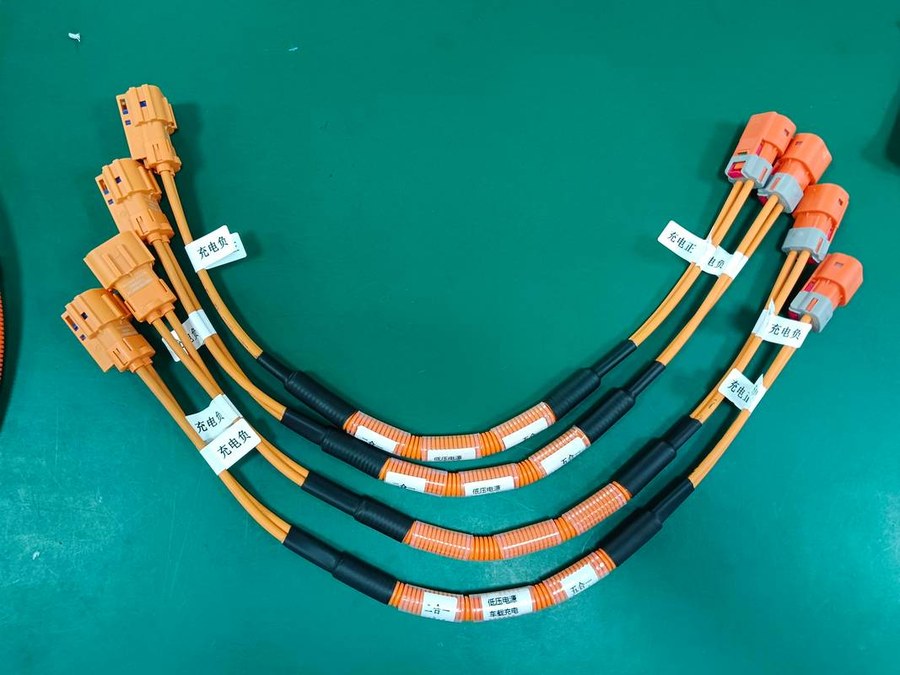
High-voltage connectors and wire harness
Seal ring compression control for high-voltage connectors

Sealing relies on the compression fit between the terminal seal rings and the housing: too little leaks, too much deforms permanently

01

I. Industry pain points: why sealing control for high-voltage connectors is difficult

1Sealing ring compression depends entirely on the dimensional chain.

After the tolerances of the terminal, sealing ring, boot, and housing stack up, the compression may fall at the lower limit, leaving insufficient contact stress on the sealing face and allowing water ingress; it may also fall at the upper limit, causing the sealing ring to be flattened over time and lose its resilience.

2The sealing ring is scratched during assembly.

Burrs on the terminal and boot, insufficient chamfers, and misalignment during assembly can all cut the sealing ring at the moment of insertion; the damage is hidden inside the mating face and cannot be found by appearance or electrical testing.

3Multi-cavity structures formed by one-shot injection molding or crimping.

Each cavity of a multi-core connector is sealed independently, and failure of any single cavity rejects the entire connector, making yield extremely sensitive to single-cavity leakage.

4OEMs generally require 100% inspection with records retained.

Once a high-voltage circuit short-circuits due to water ingress, the consequences involve personal safety, so the supply chain can only place interception at the connector ex-factory stage.

02

II. Test object and failure risks

Sealing pointsMain failure surfaces and leakage consequences

Sealing locations:

  • The sealing ring between the terminal and the boot (radial or axial compression seal);
  • The mating face between the boot and the housing (crimping, snap-fit, or interference fit);
  • The sealing ring or sealing plug at the rear cable entry.

Consequences of leakage: moisture enters the mating interface, causing creepage, reduced insulation resistance, and terminal corrosion; in severe cases, short circuits between positive and negative poles, partial discharge, and the risk of electric shock to personnel, while also causing the vehicle's IP protection and high-voltage safety requirements to fail.

03

III. Test solution: why choose the CTS A28

A28 solutionHow differential pressure comparison solves this testing challenge

High-voltage connectors are typical workpieces with small volume, large batch size, and fast cycle time, and their repeatability requirements are higher than absolute sensitivity:

  • Differential pressure comparison structure: On the basis of direct pressure, the A28 adds a differential pressure decay circuit and a differential pressure sensor. The master part and the part under test are pressurized simultaneously, and the differential pressure between them is read directly. Ambient temperature fluctuations act almost identically on the two workpieces and cancel each other out in the differential pressure channel, giving stable readings and making it suitable for small-volume workpieces.
  • Natural adaptability to small volumes: The smaller the volume, the faster the filling and stabilization, and combined with differential pressure comparison, the per-piece cycle time can be shortened without sacrificing judgment.
  • Multiple test programs and sorting: The A28 is a single-channel wall-mounted model that can store 32 test programs, covering connectors with different core counts and different terminal series; digital I/O drives fixture cylinders and pass/fail sorting, and data can be stored and uploaded to MES to meet record retention requirements.
04

IV. Test process and key points

ProcessFrom plugging and stabilization to sorting and data retention

  1. 1Mating fixture: Clamp the connector with a fixture that simulates the mated state, ensuring the sealing ring is at its design compression, and plug the end face and cable outlet.
  2. 2Filling and stabilization: Fill with dry compressed air and wait for the pressure to stabilize according to the test program.
  3. 3Testing: Enter the differential pressure test stage and compare the differential pressure change between the connector (after plugging the mating cavity and terminal holes) and the master part.
  4. 4Judgment and sorting: The instrument completes sorting via digital I/O, and rejected connectors are isolated and retained by batch to facilitate traceability of incoming sealing rings.
  5. 5Data retention: Results are stored by serial number and uploaded to MES.
Key points: The fixture clamping force must be calibrated according to the product definition; excessive clamping will additionally compress the sealing ring and cause false passes. The master part should be regularly re-verified with the built-in leak orifice standard to prevent missed rejections caused by aging of the master part's sealing ring.
05

V. Frequently asked questions (FAQ)

Q1Should air tightness testing of a high-voltage connector be performed in the mated or unmated state?

It depends on the product's sealing design. If the sealing ring only forms compression after mating, testing must be performed with a fixture that simulates mating; otherwise, the tested state does not match actual use. If sealing is completed independently by the connector's own structure, both ends can be plugged directly for testing. The specific basis is the sealing definition in the product drawing.

Q2Can air tightness testing detect a sealing ring scratched during assembly?

It can detect damage that has already affected sealing. When a scratch causes insufficient local contact stress, the cavity leak rate will exceed the test program limit and be rejected. As for shallow scratches that do not break the seal, air tightness testing does not reflect them, and they should be addressed through assembly process control and incoming burr control.

Q3Why is 100% inspection recommended for high-voltage connectors instead of sampling inspection?

Because the consequence of a single-piece failure is the risk of high-voltage short circuit and electric shock, and sealing ring damage is random and not fully correlated with batch yield. Sampling inspection cannot cover individual units whose compression falls at the lower limit; 100% inspection with records retained is the approach that matches OEM requirements.

06

VI. Conclusion

The core of sealing testing for high-voltage connectors is to intercept compression deviation and assembly damage before shipment. The CTS Sentinel A28 uses differential pressure comparison to achieve stable judgment of small-volume workpieces, and with a mating simulation fixture and 32 test programs, it meets the 100% inspection and data traceability requirements of high-volume production lines for high-voltage connectors.

07

PLUS — CTS A28 Differential Pressure Leak Detector and Sealing Test Solutions

PLUS (Guangzhou) Intelligent Technology Co., Ltd. was founded in 2018 and specializes in sealing and leak testing. It is a National High-Tech Enterprise (Certificate No.: GR202244005066) and has passed ISO 9001 quality management system certification. The company integrates technology development, production and sales, delivering high-precision air tightness testing solutions for new energy drive systems, automotive components, home appliances and general industry — including leak detector selection, custom plugging fixtures, production line integration, installation and commissioning, and personnel training.
Why differential pressure: the CTS Sentinel A28 pressurizes a master part and the part under test at the same time and reads the differential pressure between them directly. Ambient temperature drift affects both parts in nearly the same way and cancels out in the differential pressure channel, so readings are more stable than single-channel direct pressure — ideal for thin-walled parts, plastic parts and larger cavities.

CTS Sentinel A28 Differential Pressure Leak Detector

  • Differential pressure comparison, reads the difference between master part and part under test
  • Single-channel wall-mounted model with 32 storable test programs
  • Built-in calibrated leak, supports automatic calibration and self-test
  • Digital I/O drives fixture cylinders and stack light for accept/reject sorting

CTS I28 Multi-Function Single-Station Model

  • Combines several test methods in one instrument
  • Suited to large-volume cavities and multi-process testing
  • Results stored by serial number and uploadable to MES

CTS C28 Vacuum Decay / Direct Pressure Model

  • Single-part, single-method vacuum decay or pressure decay testing
  • Standard choice where ambient temperature is stable and parts are consistent
  • Complete, traceable daily check and calibration records

Plugging Fixtures and Line Integration

  • Custom-formed plugging fixtures built to the connector or contour
  • Production line integration, installation, commissioning and training
  • Equipment maintenance and instrument calibration (in-house PLUS capability)
08

Contact Us

Official Website
www.plusgz.com
Service Hotline
400 999 0513
Business Email
info@plusgz.com
Address
3rd Floor, Building A1, No. 36 Xinhe North Road, Zengcheng National Development Zone, Guangzhou, China
Contact Phone
13660225670
Company Qualifications
High-Tech Enterprise / Technology-Based SME / ISO 9001
Note: the technical parameters in this article are subject to CTS official datasheets and product manuals. The actual delivered configuration is subject to the technical agreement of the order.
Copyright © 2026 PLUS (Guangzhou) Intelligent Technology Co., Ltd. All rights reserved. 粤ICP备2023022749号
