Application of the CTS A28 Differential Pressure Leak Detector in Cold Plate Sealing Tests

PLUS (Guangzhou) Intelligent Technology Co., Ltd. | CTS Sentinel A28 differential pressure leak detector · 100% in-line inspection for Power Battery Cold Plate Sealing Test · master-part comparison · 32 test programs · traceable data
power battery cold plate sealing test cold plate air tightness test differential pressure leak detector CTS A28 battery cold plate leak test weld seam micro-leak detection

One-sentence answer: The power battery cold plate is a thin-walled part formed by welding the cold plate flow channels and the manifold. A micro-leak at the weld seam will cause coolant to seep into the battery pack and lead to insulation failure. Using the CTS Sentinel A28 differential pressure leak detector, the air tightness of the cold plate flow channels is tested by comparing a master part with the part under test, which can offset misjudgment caused by workshop temperature fluctuations to the greatest extent and is suitable for 100% inspection and sampling inspection on mass production lines.
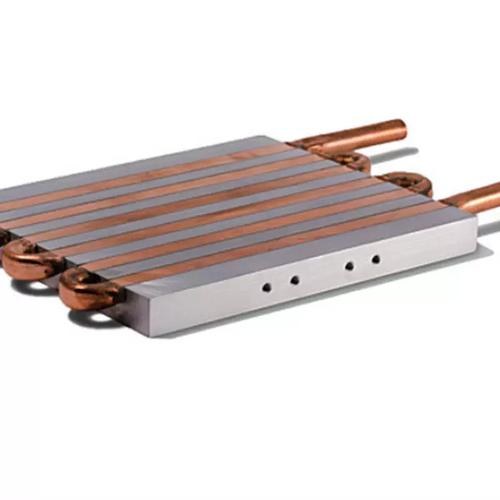
Power battery cold plate flow channels and manifold
Sealing control for cold plate flow channels and manifold welds

Long weld seams and thin walls mean micron-level pores cannot be seen before assembly; differential pressure leak testing catches them piece by piece

01

I. Industry pain points: three deadlocks in cold plate testing

1Thin-walled, large-area flow channels make micro-leaks invisible to the naked eye.

Cold plates are mostly made of aluminum using friction stir welding or brazing. The flow channels and manifold have long weld seams and thin walls. Micron-level pores are completely invisible before assembly and only leak during pressure cycling after the vehicle is assembled.

2Large workshop temperature gradients make the direct pressure method prone to misjudgment.

Cold plate testing is usually carried out in stamping and welding workshops. Day-night temperature differences and air-conditioning airflow cause the gas inside the workpiece to expand and contract with heat, making pressure readings drift. This can lead to missed detection in mild cases, or rejecting conforming parts in severe cases, and repeated retesting slows down the cycle time.

3Residual liquid and residual moisture in the flow channels interfere with testing.

After the previous cleaning process, residual moisture remains in the flow channels. After inflation, it vaporizes or condenses, causing unstable pressure and poor test repeatability.

02

II. Test object and failure risks

Sealing pointsMain failure surfaces and leakage consequences

The cold plate has three main sealing locations:

  • Weld seams between the flow channels and the manifold (brazing/friction welding seams, the most common leak points);
  • Inlet and outlet connectors (the connection between quick connectors or welded pipe joints and the plate body);
  • The mating face between the end plate and the plate body (some structures are multi-piece stacked welds).

Consequences of leakage: coolant seeps into the battery pack, reducing insulation resistance and corroding tabs and busbars, and in severe cases causing short circuits and thermal runaway. At the same time, the cooling circuit cannot maintain pressure, battery temperature control fails, and fast-charging power is forced to be derated.

03

III. Test solution: why choose the CTS A28

A28 solutionHow differential pressure comparison solves this testing challenge

The difficulty in cold plate testing is not "whether a leak can be detected," but stably distinguishing true leaks from temperature drift on large-area thin-walled parts. This is exactly the design orientation of the A28 differential pressure model:

  • Differential pressure comparison logic: Based on direct pressure, the A28 adds a differential pressure decay circuit and a differential pressure sensor. It pressurizes a known conforming master part and the part under test at the same time and directly measures the differential pressure between them. The ambient temperature affects both workpieces in approximately the same way and cancels out in the differential pressure channel, making readings more stable than single-channel direct pressure.
  • Suitable for mass production lines: The A28 is a single-channel wall-mounted model that can store 32 test programs. Different cold plate models (such as long and short versions, or different flow channel layouts) can have separate test programs, and changeover only requires calling up the program without readjusting instrument parameters.
  • Traceable calibration: It has a built-in calibrated leak standard and supports automatic calibration and self-test. Daily checks have a documented basis, meeting the quality record requirements of the automotive parts industry.

If the cold plate also needs to handle large-volume battery housings and multiple test methods need to be connected in series within the same instrument, the multi-function single-station model I28 can be used instead. If only single-piece, single-method vacuum decay testing is required, the C28 (vacuum decay/direct pressure) is also a common configuration.

04

IV. Test process and key points

ProcessFrom plugging and stabilization to sorting and data retention

  1. 1Plugging: Use a fixture to plug the inlet and outlet. The sealing surface of the fixture must be customized according to the connector shape to avoid crushing the aluminum alloy connector.
  2. 2Inflation and stabilization: Charge dry compressed air into the flow channels and wait for the airflow to stabilize according to the pressure and stabilization time set in the test program (the A28's differential pressure structure can shorten the sensitivity window to temperature drift).
  3. 3Testing: Switch to the differential pressure test stage, read the differential pressure change between the part under test and the master part, and compare it with the limit in the test program.
  4. 4Judgment and sorting/rejecting: The instrument directly drives the fixture cylinder and stack light through digital I/O to sort/reject conforming and nonconforming parts. Nonconforming parts are marked and isolated for retesting.
  5. 5Data retention: Test results are stored by workpiece serial number and can be uploaded to MES to form a traceable record for each piece.
Key tips: If there is residual cleaning liquid on the inner walls of the cold plate flow channels, a blow-drying process should be added before testing. The master part must be regularly verified with a calibrated leak to prevent systematic misjudgment caused by deterioration of the master part itself.
05

V. FAQ

Q1Should power battery cold plates be tested with the direct pressure method or the differential pressure method?

In scenarios with stable ambient temperature and high workpiece consistency, direct pressure can be used (such as the pressure decay/vacuum decay configuration of the CTS C28WE). When workshop temperature differences are large and thin walls are easily affected by temperature, the differential pressure method should be preferred. By comparing the master part with the part under test, the A28 can offset errors caused by ambient temperature fluctuations to the greatest extent and provides better stability.

Q2The cold plate weld seams are so long. How long a cycle time is needed for testing?

The cycle time depends on flow channel volume, inflation pressure, and stabilization time, and must be calibrated based on actual measurements of the workpiece. A fixed number of seconds cannot be applied universally. In practice, use a small number of workpieces for gradient testing to find the shortest stabilization time that ensures stable pressure and no missed detection, then write it into the A28 test program.

Q3How can it be confirmed that the leak detector itself has not drifted?

Use the instrument's built-in calibrated leak to perform automatic calibration and self-test, and keep calibration records. Daily pre-shift checks plus regular verification with a calibrated leak are the prerequisites for ensuring that the 100% inspection conclusions for cold plates are credible.

06

VI. Conclusion

The core of cold plate sealing testing is stably identifying true leaks under temperature disturbance. The differential pressure comparison structure of the CTS Sentinel A28 directly addresses this point. Combined with custom plugging fixtures and 32 test programs, it can cover the 100% inspection requirements of mass production lines for multiple cold plate models. For a vehicle model that needs continuous mass production for several years, choosing the right test principle is more important than piling up specifications.

07

PLUS — CTS A28 Differential Pressure Leak Detector and Sealing Test Solutions

PLUS (Guangzhou) Intelligent Technology Co., Ltd. was founded in 2018 and specializes in sealing and leak testing. It is a National High-Tech Enterprise (Certificate No.: GR202244005066) and has passed ISO 9001 quality management system certification. The company integrates technology development, production and sales, delivering high-precision air tightness testing solutions for new energy drive systems, automotive components, home appliances and general industry — including leak detector selection, custom plugging fixtures, production line integration, installation and commissioning, and personnel training.
Why differential pressure: the CTS Sentinel A28 pressurizes a master part and the part under test at the same time and reads the differential pressure between them directly. Ambient temperature drift affects both parts in nearly the same way and cancels out in the differential pressure channel, so readings are more stable than single-channel direct pressure — ideal for thin-walled parts, plastic parts and larger cavities.

CTS Sentinel A28 Differential Pressure Leak Detector

  • Differential pressure comparison, reads the difference between master part and part under test
  • Single-channel wall-mounted model with 32 storable test programs
  • Built-in calibrated leak, supports automatic calibration and self-test
  • Digital I/O drives fixture cylinders and stack light for accept/reject sorting

CTS I28 Multi-Function Single-Station Model

  • Combines several test methods in one instrument
  • Suited to large-volume cavities and multi-process testing
  • Results stored by serial number and uploadable to MES

CTS C28 Vacuum Decay / Direct Pressure Model

  • Single-part, single-method vacuum decay or pressure decay testing
  • Standard choice where ambient temperature is stable and parts are consistent
  • Complete, traceable daily check and calibration records

Plugging Fixtures and Line Integration

  • Custom-formed plugging fixtures built to the connector or contour
  • Production line integration, installation, commissioning and training
  • Equipment maintenance and instrument calibration (in-house PLUS capability)
08

Contact Us

Official Website
www.plusgz.com
Service Hotline
400 999 0513
Business Email
info@plusgz.com
Address
3rd Floor, Building A1, No. 36 Xinhe North Road, Zengcheng National Development Zone, Guangzhou, China
Contact Phone
13660225670
Company Qualifications
High-Tech Enterprise / Technology-Based SME / ISO 9001
Note: the technical parameters in this article are subject to CTS official datasheets and product manuals. The actual delivered configuration is subject to the technical agreement of the order.
Copyright © 2026 PLUS (Guangzhou) Intelligent Technology Co., Ltd. All rights reserved. 粤ICP备2023022749号
