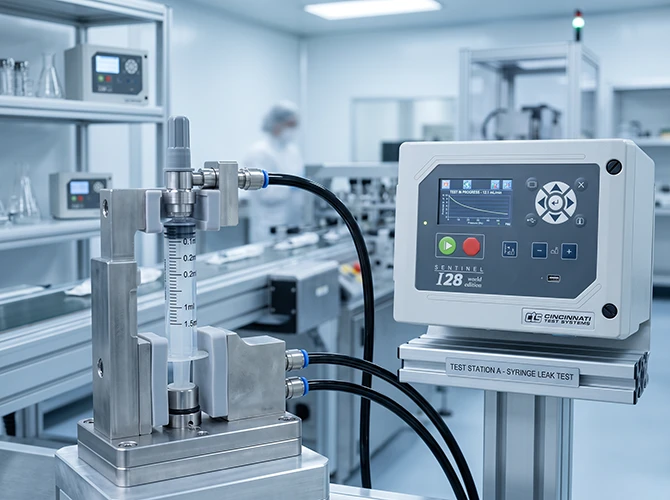
One-sentence answer: The sealing of a syringe barrel depends on the sliding seal between the barrel and the plunger rubber stopper; failure can cause inaccurate dosing or even leakage of the drug solution. With the CTS Sentinel I28 multi-function leak detector, static air tightness and flow patency tests can be run sequentially (in-series) in the same instrument, so that the static seal and the sliding seal each get their own conclusion.
The barrel-to-plunger seal sets plunger force and dose accuracy; micro-leaks usually only show up in clinical use
The plunger is under constantly changing force and motion during injection; holding pressure without leakage in a static state does not mean it is reliable during injection.
If there is a micro-leak at the press-fit or bonded joint, it only shows up when pressure is applied during injection, and visual inspection cannot find it.
Hand temperature, clamping force and air supply fluctuations all amplify reading deviations, making it easy to reject good parts.
Sealing locations: the sliding sealing surface between the barrel and the plunger rubber stopper, the bonded or press-fit surface between the needle hub and the barrel, and the mating surface between the front taper and the protective cap.Consequences of leakage: during injection, the drug solution seeps out from the needle hub or the barrel joint, so the actual dose is less than the labeled value; for prefilled products, sealing failure may lead to contamination of the drug solution. For drugs with a narrow therapeutic window, dose deviation is especially critical.
Why multiple methods in series are necessary here. The two seals of a syringe barrel are completely different in nature: the seal between the needle hub and the barrel is a static seal, which can be judged by holding pressure without a drop; the seal between the plunger rubber stopper and the barrel wall is a dynamic seal, whose reliability is related to the stopper compression, lubrication state, and fit throughout the injection stroke, and passing a static pressure hold does not indicate that there will be no leakage during injection. If both judgments are mixed into one overall pressure drop, there is no way to tell whether the defect comes from the needle hub or the rubber stopper, and the direction for rework is unclear. A more reliable sequence is to first make a static micro-leak judgment, then add a flow patency test close to the actual use condition, evaluating the sliding seal by its behavior as air flows through. Small-volume barrels also need to account for compressibility: with a small internal volume, a slight change in pressure brings obvious reading fluctuations, so the inflation and stabilization conditions must be fixed in the test program, and temperature drift compensation must be enabled.
The plunger rubber stopper is a sliding seal, and passing a static pressure hold does not mean there will be no leakage during injection. The I28 can run static micro-leak and flow patency tests sequentially (in-series) at the same station, judging with a sequence close to the actual use condition, giving a more reliable conclusion.
Enable the instrument's temperature drift compensation, fix the clamping force and stabilize the air supply to reduce fluctuations caused by the environment and fixture; perform a self-test with the built-in leak standard before each shift to confirm the instrument is in normal condition before starting testing, avoiding misjudgment.
The I28 provides EtherNet/IP and PROFINET communication, and can connect to a PLC and production line control system, or run standalone off the line; test data can be uploaded to MES for batch traceability and quality record archiving, reducing manual entry and making it easy for the quality department to review and verify at any time.
The premise of sequential (in-series) testing is merging process steps, not simply adding two tests together. Items that originally required separate clamping and separate judgment now run through in one clamping at the same station, saving transfer and re-clamping time; all stage conditions are written into the test program, and the cycle time mainly depends on the inflation and stabilization requirements.
The key to syringe barrel testing is to give both the static air tightness and the sliding seal a well-founded basis at the same station. The CTS Sentinel I28's multiple methods in series and temperature compensation, together with custom fixtures, are suitable for factory inspection on syringe-type high-volume production lines.

WeChat for technical support

PLUS Douyin