One-sentence answer: A respiratory mask is both a sealing component and a functional component. Leakage in the mask cavity or abnormal valve opening and closing directly affects ventilation performance and oxygen concentration. With the CTS Sentinel I28 multi-function leak detector, pressure decay and mass flow tests can be run sequentially in the same instrument, completing sealing and valve function judgment in one pass.
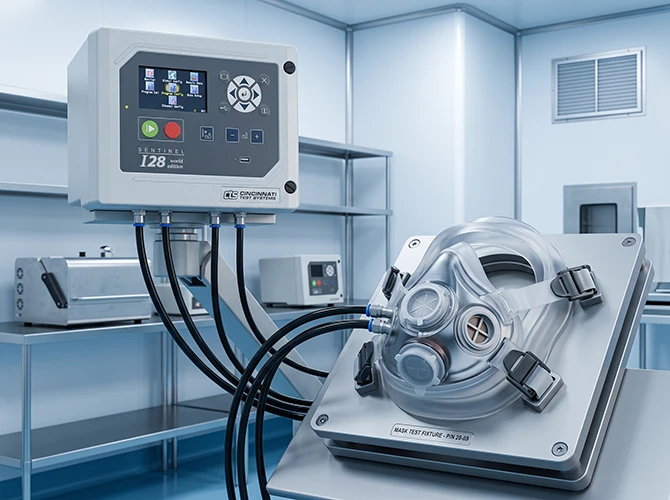
Cushion fit and valve sealing together determine leakage, so judgment must be stable at low pressure
The valve leaflet fit and opening resistance of the exhalation valve and inhalation valve are functional indicators. Testing pressure holding alone will release defective products with stuck valve leaflets.
The mask skirt and headgear buckle are soft parts such as silicone. Slightly excessive clamping force causes deformation, resulting in false leaks or false passes.
The main mask cavity and the valve cavity are semi-isolated. Different leak points must be concluded by cavity and must not mask each other.
Sealing locations: the mask body parting surface and skirt, the valve leaflet and valve seat mating surfaces of the exhalation valve and inhalation valve, the headgear buckle connection, and the oxygen tubing or corrugated tubing interface.Consequences of leakage: mask leakage prevents the oxygen supply concentration from reaching the set value; valve abnormalities cause increased breathing resistance; when positive pressure must be maintained, the mask cavity pressure cannot be sustained. All of these directly affect the safety margin of ventilation therapy.
Why multiple methods in series are mandatory here. The two types of problems on a mask are different in nature: cavity leakage is a sealing problem, shown as continuous pressure drop during pressure holding; valve sticking or poor valve leaflet fit is a functional problem, shown as abnormal resistance when air flows through, while the cavity itself may not leak at all. If only a pressure holding test is performed, products with stuck valve leaflets or excessive opening force will pass smoothly and only be exposed during use as increased breathing resistance. Once arranged in series, the pressure decay stage evaluates the sealing state of the cavity and skirt, and the mass flow stage evaluates the opening and closing performance of the valve, so the two conclusions do not mask each other. Soft masks also have their own interference sources: the skirt and headgear buckle are silicone soft parts, and slightly excessive clamping force causes deformation, resulting in false leaks or false passes. Therefore, contour support and clamping force must be fixed into the program, and temperature drift compensation must be used to suppress slow drift caused by the environment.
Air tightness only reflects whether the cavity leaks and cannot determine whether the valve leaflet fit and opening are normal. I28 runs the two types of tests sequentially in the same instrument, giving both sealing and function conclusions in one pass, avoiding passing air tightness while missing functional defects.
Yes. Support fixtures must be designed by contour and the clamping force must be fixed into the program, while temperature drift compensation is enabled; fixture and parameter combinations for different mask models can be saved as separate programs and recalled during changeover.
Program the tests for each cavity into a sequential (in-series) sequence within the same I28 instrument, judge cavity by cavity, and record results separately. No multiple instruments are needed, and there is no need to repeatedly transfer and clamp between processes, making traceability and result verification by cavity position easier.
Yes, and it cannot be omitted. There are two types of mask failure: cavity leakage and abnormal valve opening and closing. The former is a sealing problem, and the latter is a functional problem. I28 uses pressure decay to judge the cavity and mass flow to judge valve flow patency in the same sequence, screening out both types of defects and not releasing functional defects as qualified products.
The key point for respiratory masks is to accurately judge cavity sealing and valve function at the same station. The multiple methods in one instrument and sequential testing of CTS Sentinel I28, combined with contour fixtures and multiple program sets, are suitable for factory inspection on mass production lines for respiratory masks.

WeChat for technical support

PLUS Douyin