One-sentence answer: The medical catheter connector (catheter hub) is the bonded or heat-fused joint between the catheter and the Luer connector or extension tubing. A micro-leak at the joint surface causes fluid leakage and failure of the sterile barrier. With the CTS Sentinel I28 multi-function leak detector, micro-leak and flow patency tests can be run sequentially in the same instrument, so sealing and patency are judged in one pass.
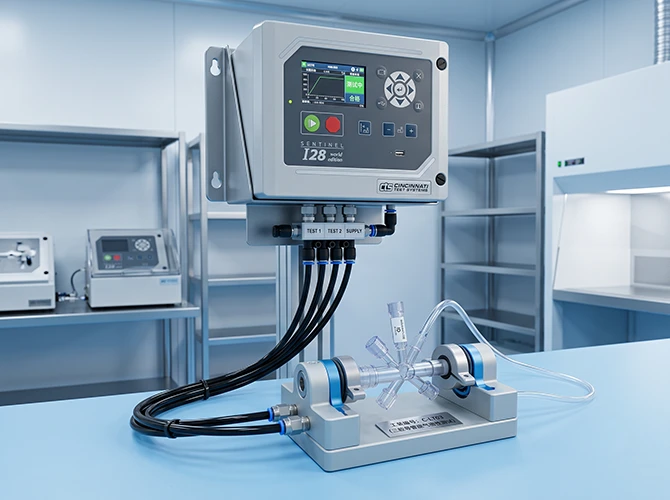
A bonding-face micro-leak and a blocked lumen look almost identical in pressure decay readings; only sequential methods separate them
The main infusion lumen, side lumen and guidewire lumen have different ports. Testing them one by one with different instruments takes up floor space and easily leaves items out.
After molding the appearance is intact, and the defect often only shows up as fluid seepage or dose deviation when pressurized infusion is performed clinically.
Slight differences in hand temperature, clamping force and inflation time will cause the pressure reading to drift.
Sealing locations: the bonded or heat-fused surface between the catheter hub and the catheter body, the Luer taper surface, the connection between the side lumen port and the hub body, and the seal ring of the spin-lock connector.Consequences of leakage: fluid seepage causes inaccurate dosing; contaminants enter the tubing through micro-leaks and cause cross contamination; the sterile barrier is destroyed. The cost of intercepting such defects at the factory end is far lower than that of exposing them at the clinical end.
Why multiple methods in series are mandatory here. Catheter hub failures fall into at least two categories: a micro-leak at the bonded surface or taper surface makes the cavity pressure drop slowly, while blockage of the inner lumen caused by adhesive debris, burrs or weld flash makes the pressure drop even faster. If only pressure decay is used, these two defect types look highly similar in the reading, so a blocked part is easily judged as a leaking part, and a true micro-leak is masked by the pressure drop from blockage. With differential pressure decay, the standard part is compared against the tested part, and ambient temperature fluctuations cancel each other in the differential pressure channel, so the micro-leak criterion holds. Then the mass flow stage directly checks whether air can pass smoothly through the inner lumen, giving a separate conclusion on patency. Small-volume parts also face the volume effect: the smaller the internal volume, the larger the share of pressure disturbance caused by temperature and clamping, so temperature drift compensation must be enabled in the sequence, and inflation and stabilization conditions must be fixed in the program to reduce human variation.
Pressure decay only reflects the pressure drop and cannot distinguish a micro-leak from inner lumen blockage. The differential pressure decay and mass flow of the I28 can run sequentially in the same instrument, judging micro-leak first and then patency, with separate conclusions for the two defect types, reducing missed and false judgments.
The I28 supports storage of multiple test programs. For changeover, simply call up the corresponding program without readjusting instrument parameters. Together with replaceable plugging fixtures, one machine can cover multiple catheter hub specifications without purchasing additional instruments.
Test parameters and results are stored by workpiece or batch and can be uploaded to MES through the communication interface, forming electronic data that corresponds one-to-one with batch records. This facilitates traceability and release review under the quality system and also reduces manual transcription errors.
Because the catheter hub carries both micro-leak and blockage risks at the same time, and the reading of a single method cannot separate the two. Only by running pressure decay, differential pressure decay and mass flow in series can each defect type have its own criterion, avoiding covering two failure modes with one conclusion, and making it easier to route defects to the correct rework direction.
The difficulty with the catheter hub is that micro-leak and patency must be judged accurately at the same station. The multiple methods in one instrument of the CTS Sentinel I28, combined with custom fixtures, is suitable for factory air tightness inspection on catheter production lines with multiple specifications.

WeChat for technical support

PLUS Douyin