One-sentence answer: The seal assembly of a laparoscopic trocar determines the pneumoperitoneum maintenance capability during repeated instrument insertion and withdrawal. Failure of the seal cap or duckbill valve will cause abdominal air leakage. With the CTS Sentinel I28 multi-function leak detector, pressure decay and mass flow testing can be run sequentially (in-series) in the same instrument, completing both static seal and valve port function judgment in one pass.
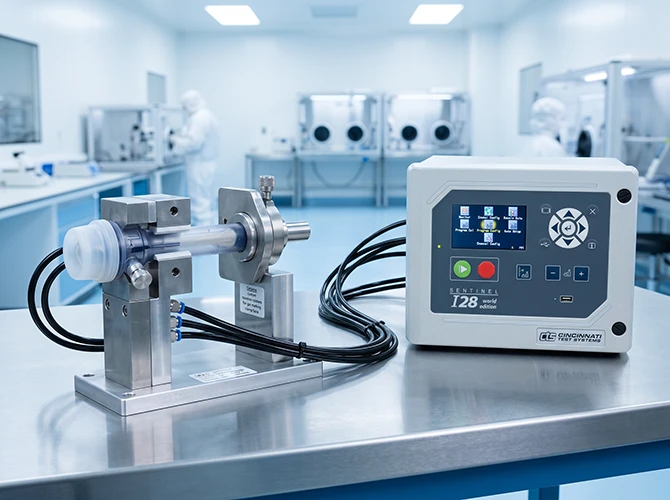
Seal cap and duckbill valve maintain pneumoperitoneum; micro-leaks and moving-part seals must be judged at low pressure
After the instrument passes through the seal, the lip must rebound and conform. Products with poor rebound only expose the problem during surgery.
The outer seal cap and the inner duckbill valve handle different working conditions. Failure of either one will cause air leakage.
A pressure hold test alone cannot reflect defects such as valve flap sticking or abnormal opening force.
Sealing locations: the connection surface between the seal cap and the outer tube hub, the sealing surface of the duckbill valve port, the joint between the sealing membrane and the outer tube, and the insufflation valve interface.Consequences of leakage: intraoperative pneumoperitoneum leakage leads to abdominal collapse and loss of visual field, forcing the surgery to be interrupted; seal failure during instrument insertion and withdrawal increases infection risk; disposable products cannot be reworked and can only be replaced on site.
Why multiple methods in series are mandatory here. A trocar has two seals under different working conditions: the outer seal cap provides static sealing when the instrument is at rest, while the duckbill valve must keep its lip rebounding and conforming during repeated instrument insertion and withdrawal, which is a dynamic seal. Passing a static pressure hold does not mean the lip can still close after the instrument passes through; and valve flap sticking or abnormal opening force is a functional issue that a pressure hold test cannot reflect at all. If only a single overall pressure drop is performed, static and dynamic defects are mixed together, making it impossible both to distinguish them and to locate the specific seal stage. A reasonable arrangement is to first use pressure decay to judge the static sealing of the seal cap and valve port, then add a segment in the sequence that retests after simulating instrument passage and compare the conclusions before and after puncture, and finally use a mass flow segment to confirm normal flow at the valve port.
The seal cap and duckbill valve must not only be leak-free, but also open and close properly during instrument insertion and withdrawal. The I28 runs the two test types in series, avoiding the situation where air tightness passes but defects such as valve flap sticking or abnormal opening force are missed, giving more complete judgment coverage.
Add a retest segment after simulating instrument passage to the I28 test sequence and compare the seal conclusions before and after puncture. This screens out products with poor rebound and handles them separately, preventing them from flowing into the next process.
No. Program the outer seal cap and the inner duckbill valve as a sequential (in-series) program in the same instrument, judge stage by stage and record separately. This saves repeated fixturing and makes it easier to trace and locate problems by seal stage.
They should be read together with the two sets of results: static and after passage. Static pass but out-of-limit after passage indicates insufficient lip rebound; out-of-limit even when static indicates a defect in the sealing surface itself. The I28 programs both segments in the same sequence and records them separately, locating by difference, which makes it easier to distinguish an assembly problem from a seal part problem.
The key point for laparoscopic trocar seal assemblies is to judge static sealing and valve port function accurately in one pass. The CTS Sentinel I28, with multiple methods in series and dedicated fixturing, is suitable for factory sealing and functional inspection of disposable trocar products.

WeChat for technical support

PLUS Douyin
