One-sentence answer: Once the seal of an infusion bag or infusion tubing fails, it will cause liquid leakage, contamination and destruction of the sterile barrier. With the CTS Sentinel I28 multi-function leak detector, pressure decay and mass flow testing can be run sequentially (in-series) within the same instrument, continuously completing weld seam sealing and tubing flow patency determination.
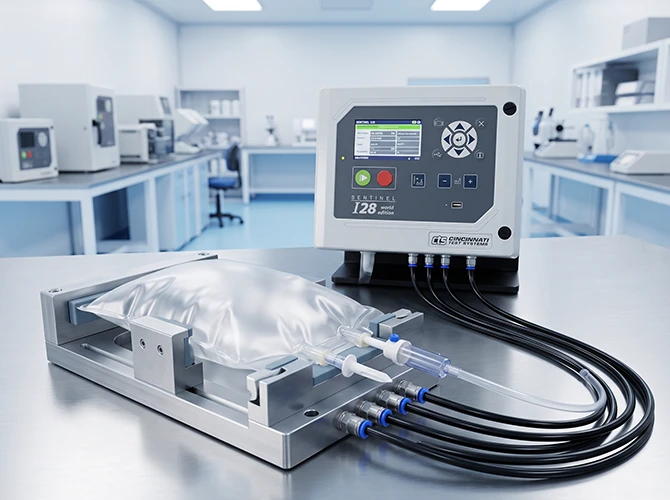
Bag welds and tubing ports are the main leak paths and must be screened piece by piece for micro-leaks and blockage
The sealing edges of multi-layer film bag bodies and the welding areas of connector seats cover a large area, and micro-holes only show up as liquid seepage during filling or pressurized infusion.
The inner lumen of the tubing is long and narrow, and the pressure decay reading is affected by both micro-leaks and blockage; measuring pressure drop alone easily judges a blocked tube as a leaking part.
After filling, the soft bag is affected by the weight and temperature of the liquid; the film material softens and the internal pressure changes, so the conclusion must cover this state.
Sealing locations: the heat-sealed seams around the bag body, the welding area between the connector seat and the bag body, the sealing surfaces of the drug addition port and the puncture port, and the connections between the tubing and the drip chamber and connectors.Consequences of leakage: liquid seeps out and contaminates the environment and equipment; destruction of the sterile barrier brings a risk of bacterial contamination; tubing blockage causes interruption of drug delivery. Once leakage is found clinically in soft bag products, the entire batch often has to be traced and handled.
Why multiple methods in series are essential here. The failure modes of infusion bags and tubing differ greatly: micro-holes in the heat-sealed seam appear as slow seepage, while blockage, kinking or foreign matter in the tubing changes pressure in another way. Both phenomena appear in the pressure decay reading as pressure dropping quickly; an overall pressure drop alone cannot distinguish whether the weld seam is leaking or the tubing is obstructed, and therefore cannot give the correct direction for action. Using pressure decay to judge weld seam sealing and mass flow to judge tubing patency keeps the two types of conclusions independent, so that problem localization has a basis. In addition, a soft bag is an elastic thin-wall structure; after inflation its volume expands with pressure, and the reading shows an obvious volume effect; the large volume also slows pressure stabilization, so the stabilization time must be calibrated according to actual measurements of the workpiece, together with temperature drift compensation, to avoid misreading drift caused by thermal expansion and contraction as leakage.
Overall pressure decay cannot distinguish whether it is a micro-leak in the bag body or a blockage in the tubing. I28 runs pressure decay and mass flow sequentially (in-series) within the same instrument, giving separate conclusions on weld seam sealing and tubing patency, which makes problem localization easier.
Readings for large-volume parts are more sensitive to temperature and stabilization time; the stabilization time must be calibrated according to actual measurements of the workpiece and temperature drift compensation must be enabled. Calibration results for different specifications can be saved separately in the test program and called up directly during changeover.
The air tightness test uses a dry, oil-free and water-free clean air source; the tubing remains dry and no new liquid contamination is introduced. The plugging fixture is customized to the connector shape to avoid scratching the connector or leaving residual liquid that affects subsequent use.
Both cause pressure to drop, and pressure drop alone cannot distinguish them; the criterion must be based on the path. A micro-leak is continuous outward leakage, while blockage is restricted air flow. I28 uses pressure decay to judge weld seam sealing and mass flow to judge tubing patency, separating the two phenomena so that a blocked tube is not treated as a leaking part and production line handling does not go in the wrong direction.
The key point for infusion bags and tubing is to accurately judge both weld seam micro-leaks and tubing patency at the same time. The multiple methods in series of the CTS Sentinel I28, together with segment-by-segment plugging fixtures and multiple test programs, is suitable for factory sealing inspection on mass production lines for infusion products.

WeChat for technical support

PLUS Douyin
