One-sentence answer: A hemodialysis filter requires both the blood side and the dialysate side chambers to be sealed simultaneously, with no cross-leakage between the two sides. With the CTS Sentinel I28 multi-function leak detector, multiple test segments can be run sequentially (in-series) within the same instrument to separately determine blood-side sealing, dialysate-side sealing, and membrane integrity.
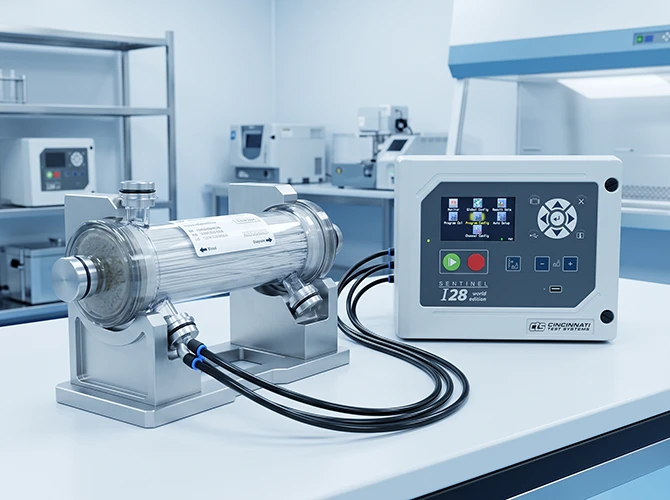
Dual-chamber sealing and membrane integrity have to be judged separately; failure of either causes cross-contamination
Testing overall air tightness alone cannot detect a micro-leak between the two sides, and cross-leakage is precisely the most serious failure mode.
The hollow fiber membrane itself is permeable, so pressure decay changes include both leakage and the membrane's normal breathing behavior.
After the membrane is wetted, its permeability changes, so test conditions must be standardized and recorded; otherwise, batch-to-batch data is not comparable.
Sealing locations: the bonded or welded surfaces between the filter housing and end caps, the blood-side port, the dialysate-side port, and the potting surface where the hollow fiber membrane bundle is sealed.Consequences of leakage: cross-leakage between the two sides causes blood and dialysate to mix, which is a serious safety risk; membrane damage leads to abnormal solute clearance and blood loss; poor sealing causes blood leakage or air ingress in the circuit. These failures are often irreversible in clinical use.
Why multiple methods in series are mandatory here. The most serious failure mode of a filter is cross-leakage between the blood side and the dialysate side, and an overall air tightness test is precisely the least able to detect it: when the whole unit is pressurized, both sides are under pressure at the same time, and the pressure change caused by cross-leakage is absorbed jointly by the two chambers, so no abnormality is visible in the readings unless the two chambers are pressurized separately and judged individually. In addition, the hollow fiber membrane itself is permeable, so pressure decay changes include both housing leakage and the membrane's normal breathing behavior; if a single pressure decay criterion is used, normal membrane permeability can easily be misread as leakage, or conversely a real leak can be masked by membrane permeability. The sequence must therefore be segmented: first use pressure decay or differential pressure decay to separately judge the housing and port sealing of each chamber, then use a mass flow type criterion to evaluate membrane integrity, and finally confirm the partition between chambers.
An overall test cannot distinguish cross-leakage between the two sides, and cross-leakage is the most serious failure mode. The I28 uses a sequential (in-series) sequence within the same instrument to pressurize and judge the two chambers separately, so cross-leakage can be screened out separately from other defects.
The membrane itself is permeable, so a mass flow or pressure-hold performance criterion must be used under standardized conditions. The I28 can judge membrane integrity and housing sealing separately, avoiding the two conclusions interfering with each other and causing distortion.
The membrane permeability in the two states is inherently different; the key is to standardize the conditions and write them into the test program. Using the same process and the same criterion for the same batch of products is what makes batch-to-batch data comparable and traceable.
No. When the whole unit is pressurized, both chambers are under pressure at the same time, and the pressure change caused by cross-leakage is absorbed jointly by the two chambers, so no abnormality is usually visible in the readings. The I28 pressurizes and judges the two chambers separately, then uses an independent segment to confirm the partition between chambers, so cross-leakage can be screened out separately from other defects and the most serious safety failure is not released by mistake.
The key point for hemodialysis filters is the separate determination of dual-chamber sealing and membrane integrity. The multi-segment sequential (in-series) testing and recordable programmed conditions of the CTS Sentinel I28 make it suitable for factory sealing and integrity inspection of high-value dialysis consumables.

WeChat for technical support

PLUS Douyin