One-sentence answer: Flexible endoscope handles must meet whole-unit water resistance requirements. If the handle cavity or insertion tube seal fails, cleaning and disinfection fluids can intrude, causing electrical and optical failures. With the CTS Sentinel I28 multi-function leak detector, differential pressure decay and mass flow testing can be run sequentially in the same instrument, completing sealing and flow patency judgments lumen by lumen.
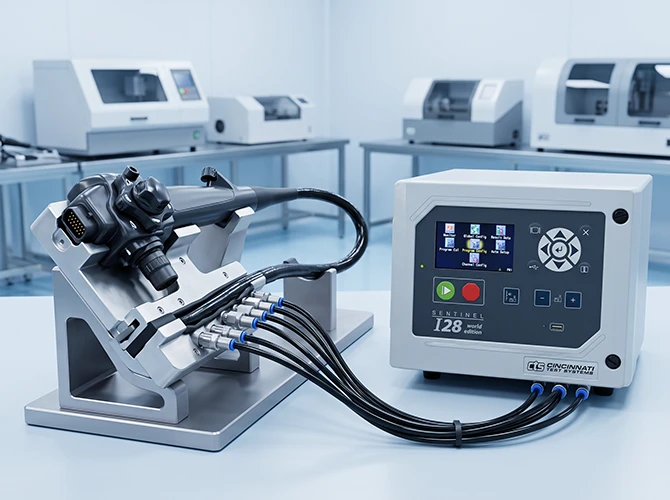
Ports differ from lumen to lumen; one clamping setup has to test leakage and patency for all of them
The air, water, suction and instrument channels are each sealed independently, and failure of any one lumen undermines the water resistance conclusion for the whole unit.
The insertion tube and bending section are flexible structures that deform easily under plugging and pressurization, causing readings to fluctuate.
Whole-unit water resistance is verified according to the corresponding IP rating in IEC 60529 / GB/T 4208, and process data must be traceable to each individual unit.
Sealing locations: handle housing parting surfaces and seals, the connection between the insertion tube and the handle base, the bending section covering, and the joint between the connector and the handle.Consequences of leakage: intrusion of cleaning and disinfection fluids causing failure of the image sensor, illumination and circuits; residual fluid inside creating cross-contamination risk; failure to meet the whole-unit water resistance rating. If re-inspection after repair is inadequate, the risk carries over to the next use.
Why multiple methods in series are essential here. The air, water, suction and instrument channels in the handle are each sealed independently, and loss of sealing in any one lumen undermines the whole-unit water resistance conclusion; at the same time, each channel must remain unobstructed, otherwise function is affected. If a single overall pressure drop were used for judgment, differences between lumens would be averaged out, the location of the leak could not be determined, and a blockage in one lumen could even be misjudged as a whole-unit leak. Using differential pressure decay to judge lumen by lumen compares the pressure difference change between a master part and the test part, so ambient temperature fluctuations cancel out in the differential pressure channel, giving sufficient resolution for small-volume cavities; adding a mass flow stage then confirms the channel is not blocked, so both the sealing and flow patency conclusions hold. Small volume also means volume effects are significant, and filling and stabilization conditions should be fixed into the test program according to lumen type.
The handle interior is multi-lumen and small in volume, so direct pressure readings are easily disturbed by temperature and operating sequence. Differential pressure decay compares a master part with the test part, canceling most ambient temperature fluctuations, and gives more stable readings than a single direct pressure channel.
Whole-unit immersion protection must be verified in the laboratory according to the corresponding IP rating in IEC 60529 / GB/T 4208. On the production line, air tightness testing is used as an equivalent process control. Only when the two work together can sealing reliability be ensured while also balancing production takt time and inspection efficiency.
Multiple instruments are not required. The I28 can program the tests for each channel into a sequential (in-series) sequence within the same instrument, judging lumen by lumen and recording each separately, reducing errors from transfer and repeated fixturing, and making it easier to locate problems by channel.
It does have an effect. It is recommended to judge each lumen independently and in a fixed order. If multiple lumens are mixed into a single pressure drop test, the lumen to which a defect belongs cannot be determined, and interaction between upstream and downstream lumens may mask the true leak. The I28 programs each lumen into a fixed sequence and judges lumen by lumen, so results are reproducible and locatable.
The difficulty with endoscope handles lies in multi-lumen discrimination and fixturing of flexible sections. The CTS Sentinel I28's multiple methods in series, temperature drift compensation and traceable records make it suitable for factory and post-repair sealing inspection of flexible endoscopes.

WeChat for technical support

PLUS Douyin