In recent years, new energy has developed rapidly. As the core components of electric vehicles, the sealing test of new energy motors and motor controllers directly affects the safety of the entire vehicle. To improve sealing and waterproof performance, the enclosure of the motor must meet the IP67 design rating to ensure its sealing and waterproof integrity, preventing short-circuit accidents caused by water ingress. So how can we ensure that the product achieves the IP67 rating? After testing is completed, the product must go through a series of processes including packaging, transportation, unloading, and vehicle assembly before it is put into market use. During this period, collisions and deformation may occur, ultimately leading to short circuits, smoke, or even fire. Therefore, sealing testing of motors, motor controllers, and similar components is extremely important.
Using an air tightness leak detector offers strong consistency and enables data traceability. If a product develops issues, it can be traced back to its condition or data at the time of initial shipment. It also has low subjectivity and does not depend on the operator.
I. Test Method Analysis:
1. Differential pressure test method:
During inflation, the test valve group shown in the figure opens, and the pressure on both ends of the differential pressure sensor is the same. When stabilization begins, the test valve group closes, the pressure on the right side of the differential pressure sensor remains constant, while the other side is connected to the test workpiece; if there is a leak at the product end, the pressure on the left side drops. The differential pressure sensor compares the pressures at both ends, thereby detecting minute leaks. This method is currently one of the most widely used testing methods.
Features:
1. High test pressure (up to 50 kg)
2. High test signal resolution, independent of pressure level
3. By using a standard workpiece as a reference in the test system, perform leak testing on workpieces with unstable conditions.
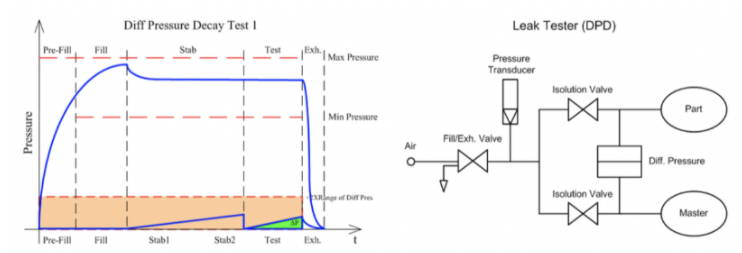
The principle of differential pressure testing involves adding a higher-precision differential pressure sensor to the test circuit. As is well known, sensor accuracy is related to the sensor's measurement range. The differential pressure sensor introduced by the differential pressure test method has a relatively small range, typically ±2 kPa or ±500 Pa, and the detection sensitivity is improved to 0.1 Pa, making it suitable for detecting minute leaks in products. In practical applications, the differential pressure method connects the reference port and the test port to a reference volume and the workpiece under test respectively, which to a certain extent offsets the pressure fluctuation error caused by temperature effects on the product, thereby improving the stability of the test results.
2. Flow testing method:
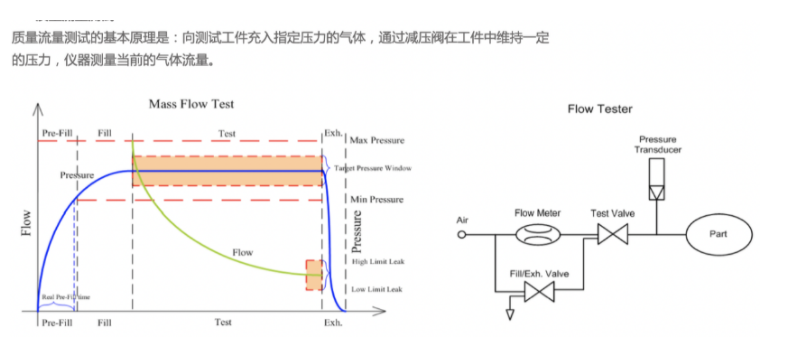
The image above shows the principle and analysis of the mass flow method testing. The mass flow method uses a mass flow sensor to directly measure the flow value, whereas the differential pressure method measures the pressure change (in Pa) and then converts it to the corresponding leak rate using Bernoulli's equation. Compared with the differential pressure method, the mass flow method has the following advantages:
1. The test signal is independent of the size of the volume under test and the level of the test pressure.
2. Suitable for workpieces with a relatively large volume but a small allowable leak rate.
3. Atmospheric pressure and temperature have little effect on the measurement result, and the measurement signal directly corresponds to the leak rate under standard conditions. There is no need to derive the leak rate through pressure measurement and conversion.
4. After adding fast charging, the test time can be shortened.
5. Since the reference part and the test part are in the same environment, they are less affected by environmental factors.
Sealing tests for new energy motors and controllers are usually divided into cooling water channel tests and assembly tests. The water channel test pressure is generally 2-3 bar, with 20s inflation, 40s balance, and a leak rate of ≤4 ml/min. However, some customers set very high leak requirements, at 0.5 ml/min or even lower, which requires helium mass spectrometer leak detection equipment to meet such requirements. The assembly test requirements are defined according to different customer requirements. For example, for a domestic motor manufacturer we serve, the test pressure used is negative pressure of -20 Kpa, but many domestic manufacturers mostly use positive pressure for testing. The leak rate or pressure decay value also varies from one manufacturer to another.
II. Air Tightness Testing and Sealing Methods for Motors and Controllers
When conducting air tightness testing, we need to seal the connectors of motors or controllers. As most customers currently perform testing in a semi-automatic state, many still choose to seal connectors by manually applying glue to the terminals. It is believed that as automation requirements increase, many customers will also adopt automated pneumatic sealing solutions. For water channel sealing, quick-seal connectors are typically used, enabling rapid sealing and improving production efficiency.

WeChat for technical support

PLUS Douyin