One-sentence answer: The underwater thruster pod is a pressure-bearing component; leakage at the motor compartment or shaft seal will directly cause water ingress and motor damage. With the CTS Sentinel I28 multi-function leak detector, multiple pressure test stages can be run sequentially (in-series) within the same instrument to separately evaluate the pod's static seal and the shaft system's dynamic seal.
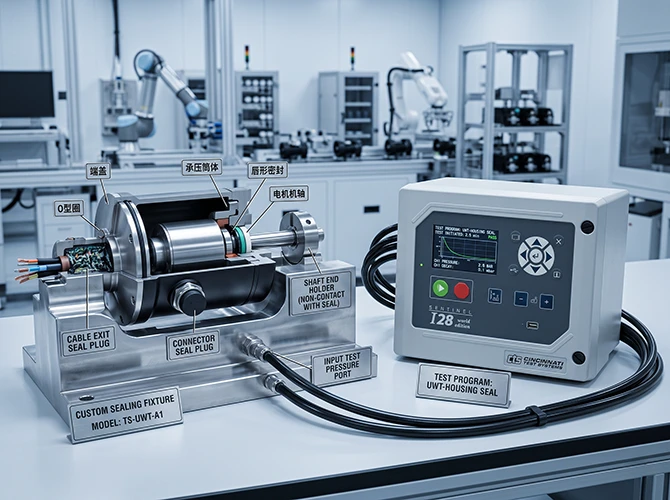
In continuous immersion service, pod welds, shaft seals and cable outlets all have to be judged strictly
The motor shaft relies on a mechanical seal or lip seal to isolate water from the windings, and defects at this location are often not obvious under static conditions.
The end cap seal is a static leakage path, while the shaft seal is related to the contact condition under rotating operation; measuring total leakage indiscriminately cannot locate the defect.
Underwater equipment operates according to its design pressure rating, and sealing margin needs to be verified through staged pressurization; a single pressure point is not sufficient to demonstrate the issue.
Sealing locations: the end face seal or O-ring between the pod end cap and the cylinder body, the mechanical seal or lip seal of the motor shaft, the cable outlet and potting surface, and the mating surface between the connector and the housing.Consequences of leakage: water ingress causes short circuits in the motor windings and damage to the drive board and controller; in deep-water operations, seal failure often becomes apparent mid-mission, and recovery and repair costs are extremely high.
Why multiple methods in series are essential here. The pod end cap is a static seal, and it can be judged as acceptable as long as no continuous pressure drop occurs during the hold period; the mechanical seal or lip seal of the motor shaft is a rotating dynamic seal, and its leakage is related to the actual rotational speed, medium pressure, and lip contact condition, so its behavior under static conditions does not represent the rotating condition. If the two are combined into a single overall test, the total leakage behavior contains contributions from both the end cap and the shaft seal, and it is impossible to distinguish where the defect lies, so rework requires complete disassembly of the unit. More critically, the sealing margin of underwater equipment needs to be verified in stages according to the design pressure rating—if testing is performed at only a single pressure point, those sealing defects that only appear at higher differential pressures will be missed. By running multiple program stages in series within the same instrument, the end cap static seal is evaluated first, followed by the shaft seal and cable potting area, so both the defect location and the sequence of instability can be identified.
The shaft end sealing area is first evaluated under static conditions to determine whether it meets the criteria, as a factory process control item; complete evaluation of the dynamic seal requires testing under rotating conditions, and the two evaluation sets can be arranged in the sequence of the same instrument.
Staged pressurization allows observation of sealing performance under different differential pressures, exposes defects that only appear at higher differential pressures, and also helps identify whether the end cap seal or the shaft seal becomes unstable first, making rework more targeted.
No. The I28 runs multiple test program stages in series within the same instrument, evaluating and recording the static seal and shaft seal areas separately, reducing secondary fixturing and inter-process transfer, and making results easy to correspond to and trace per workpiece.
Because their failure mechanisms and criteria are different. A combined test yields only a total leakage behavior, making it impossible to tell whether the problem lies in the end cap or the shaft seal, and the rework direction is unclear. The I28 organizes the static seal and shaft seal areas into different stages for separate evaluation and recording, and can also work with staged pressurization to observe the sequence of instability.
The key point for underwater thruster pods is the staged evaluation of the static seal and dynamic seal. The multi-stage sequential capability and staged pressurization program of the CTS Sentinel I28 make it suitable for factory sealing inspection and post-repair re-inspection of underwater power equipment pods.

WeChat for technical support

PLUS Douyin