Application of the CTS I28 in Potting Surface and Terminal Feed-Through Sealing Tests

PLUS (Guangzhou) Intelligent Technology Co., Ltd. | CTS Sentinel I28 multi-function leak detector · 100% in-line inspection for Servo Drive Housing Sealing Test · multiple test methods in one instrument · temperature drift compensation · traceable data
servo drive housing sealing test servo drive air tightness test multi-function leak detector CTS I28 potting surface leak test terminal feed-through sealing

One-sentence answer: The sealing of a servo drive housing affects the reliability of power devices and circuit boards in oil mist and metal dust environments. With the CTS Sentinel I28 multi-function leak detector, two types of tests—housing air tightness and cavity isolation—can be run sequentially (in-series) at the same station, first judging leakage and then judging air duct cross-communication.
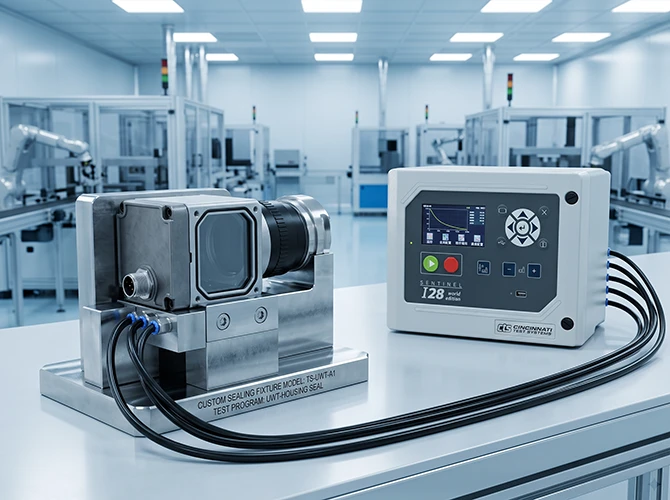
Servo drive housing with terminal feed-through
Potting surface and terminal feed-through sealing for servo drives

Potting voids and terminal feed-throughs are typical leak points; liquid ingress destroys power devices

01

I. Industry Pain Points: Three Difficulties in Servo Drive Testing

1The air duct and the circuit cavity must not communicate with each other.

If the partition between the cooling air duct and the circuit cavity is poorly sealed, oil mist and dust will be carried by the airflow directly into the power device area, and testing overall air tightness alone cannot detect this.

2The potting surface is a sealing path formed later in the process.

The bonding interfaces between the potting layer and the housing and terminals are independent and easily overlooked, and defects are often averaged out in whole-unit testing.

3The terminal feed-through relies on separate sealing.

The gaskets or O-rings of multi-pin terminals can lose sealing locally under assembly deviation.

02

II. Test Object and Failure Risks

Sealing pointsMain failure surfaces and leakage consequences

Sealing locations: housing parting surface and end cover, terminal feed-through mating surface, potting surface and pouring port, and the partition seal between the cooling air duct and the circuit cavity.Consequences of leakage: intrusion of oil mist and metal dust causes creepage, short circuits, and drive failure; cooling airflow carries contaminants directly into the power device and busbar area; failure to meet the protection rating limits operating conditions.

03

III. Test Solution: Why Choose the CTS I28

I28 solutionHow sequential multi-method testing covers this part

  • Multiple methods in one instrument: Servo drives require both housing air tightness and isolation between the air duct and the circuit cavity. The I28 offers pressure decay, differential pressure decay, and mass flow configurations on the same platform, and supports running both types of tests sequentially (in-series) within one instrument—first judging leakage, then judging cross-communication.
  • Changeover and integration: Housings of different power ranges can be set up with separate test programs for fast changeover; EtherNet/IP and PROFINET allow connection to a PLC or standalone operation.

Why multiple methods in series are essential here. There are two types of problems with different natures on a drive: one is external leakage at the housing, end cover, and terminal feed-through, which is a sealing issue; the other is loss of sealing in the partition between the cooling air duct and the circuit cavity, which is a cavity isolation issue. The latter is almost invisible in an overall air tightness test—both sides of the partition are inside the enclosure, so no external pressure drop is generated when the whole unit is pressurized. But once the seal fails, the cooling airflow will carry oil mist and metal dust directly into the power device area, with consequences as serious as water ingress. Therefore the criteria must be separated: pressure decay judges external sealing, and mass flow judges whether there is an unwanted path between the air duct and the circuit cavity. The potting surface is an independent sealing path formed later in the process, and the bonding interfaces between the potting layer and the housing and terminals also need to be judged in a separate program segment.

04

IV. Test Process and Key Points

ProcessFrom plugging and pressurizing to sequential testing and data retention

  1. 1Clamping and plugging: Position by housing outline, and plug the terminal face, air duct openings, and process holes.
  2. 2Pressurization: Inflate the circuit cavity according to the test program and stabilize the pressure.
  3. 3Sequential (in-series) testing: First judge the air tightness of the housing and potting surface, then proceed to the isolation judgment between the air duct and the circuit cavity.
  4. 4Sorting/rejecting: Digital I/O drives sorting/rejecting, and housings of abnormal drives are isolated.
  5. 5Record retention: Results are uploaded by drive model and batch.
Key notes: The assembly orientation of the gaskets for multi-pin terminals must be fixed in the process; the air supply must be dry and oil-free.
05

V. FAQ

Q1Why must the isolation between the air duct and the circuit cavity be tested separately on a servo drive?

In an air-cooled structure, airflow passes through the enclosure. If the partition loses sealing, contaminants are carried by the airflow directly into the power device area. The I28 uses a mass flow segment to judge this path separately, preventing an overall air tightness test from masking the problem.

Q2How is the sealing of the potting surface ensured?

The potting surface is an independent leakage path and must be judged in a separate program segment, and controlled together with potting layer curing process parameters and visual inspection. Relying only on whole-unit pressure holding tests tends to result in missed judgments and repeated re-testing.

Q3Can housings of different power ranges share one instrument?

Yes. The I28 supports storage of multiple test programs, saving parameters and test sequences separately by housing model. During changeover, simply call up the corresponding program—there is no need to readjust instrument parameters or fixture cycle time, making changeover faster.

Q4Is a failed air duct isolation test considered a sealing problem?

Yes, and it is a critical one. A failed partition seal does not generate an external pressure drop, so an overall air tightness test cannot detect it, but the cooling airflow will carry oil mist and dust directly into the power device area. The I28 uses a mass flow segment to specifically confirm whether the air duct and circuit cavity communicate, screening out this type of hidden risk separately.

06

VI. Conclusion

The key point for servo drive housings is the separate judgment of air tightness and cavity isolation. The multi-method sequential (in-series) testing and multiple program capabilities of the CTS Sentinel I28, together with dedicated fixtures for terminals and air ducts, are suitable for batch factory sealing inspection of servo drives.

07

PLUS — CTS I28 Multi-Function Leak Detector and Sealing Test Solutions

PLUS (Guangzhou) Intelligent Technology Co., Ltd. was founded in 2018 and specializes in sealing and leak testing. It is a National High-Tech Enterprise (Certificate No.: GR202244005066) and has passed ISO 9001 quality management system certification. The company integrates technology development, production and sales, delivering high-precision air tightness testing solutions for medical devices, robotics, industrial control equipment and smart meters — including leak detector selection, custom plugging fixtures, production line integration, installation and commissioning, and personnel training.
Why the I28: the CTS Sentinel I28 is a multi-function single-station instrument that offers pressure decay, differential pressure decay and mass flow configurations on one platform, and can run different test types in sequence inside the same instrument — one clamping setup completes the full "micro-leak first, then flow patency" sequence, so a blockage is never misread as a leak. Temperature drift compensation can be enabled in the sequence, and EtherNet/IP and PROFINET let it run standalone or talk to a PLC.

CTS Sentinel I28 Multi-Function Leak Detector

  • Pressure decay, differential pressure decay and mass flow configurations
  • Sequential multi-stage testing inside one instrument, one clamping setup
  • Multiple stored test programs for fast changeover
  • Temperature drift compensation for small-volume, temperature-sensitive parts
  • EtherNet/IP and PROFINET, standalone or PLC-integrated

CTS C28 Pressure / Vacuum Decay Model (optional)

  • Pressure decay and vacuum decay in one unit, plus blockage testing
  • Absolute pressure sensor with ambient drift correction for large volumes
  • Compact single-channel wall-mount with 32 test programs

CTS A28 Differential Pressure Model (optional)

  • Master part and part under test pressurized together, differential pressure read directly
  • Preferred for thin-walled and plastic parts with large temperature gradients
  • Combines with the I28 for component-level and assembly-level testing

Plugging Fixtures and Line Integration

  • Custom-formed plugging fixtures with quick changeover
  • Production line integration, installation, commissioning and training
  • Equipment maintenance and instrument calibration (in-house PLUS capability)
08

Contact Us

Official Website
www.plusgz.com
Service Hotline
400 999 0513
Business Email
info@plusgz.com
Address
3rd Floor, Building A1, No. 36 Xinhe North Road, Zengcheng National Development Zone, Guangzhou, China
Contact Phone
13660225670
Company Qualifications
High-Tech Enterprise / Technology-Based SME / ISO 9001
Note: the technical parameters in this article are subject to CTS official datasheets and product manuals. The actual delivered configuration is subject to the technical agreement of the order.
Copyright © 2026 PLUS (Guangzhou) Intelligent Technology Co., Ltd. All rights reserved. 粤ICP备2023022749号
