One-sentence answer: The reducer and motor inside a robot joint module have high sealing requirements. Failure of the housing seal or oil seal will cause grease leakage and intrusion of external cutting fluid. With the CTS Sentinel I28 multi-function leak detector, multiple test stages can be run sequentially in one instrument and the breathing effect of the joint cavity can be compensated.
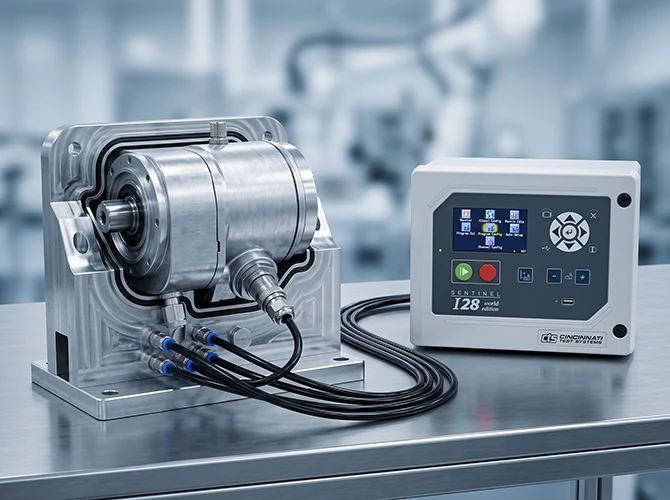
Joint cavities breathe with temperature, so testing must compensate for temperature and volume-induced reading drift
Leakage often starts at the mating surface between the lip and the shaft. Appearance and assembly dimensions are normal, and seepage only appears after a period of operation.
The joint heats up during operation and cools down when stopped. The cavity pressure fluctuates with temperature, and the slowly changing reading is easily judged as a leak.
The cable outlet, connector, and end cap seal ring are each independent. Testing only the complete unit will mask the specific leak location.
Sealing locations: joint housing parting surface and end cap seal ring, reducer input/output shaft oil seal, cable outlet seal, mating surface between connector and housing, breathing element for balancing internal pressure.Consequences of leakage: grease seepage contaminates the working environment and workpieces; cutting fluid and dust intrusion cause reducer wear and encoder failure; positioning accuracy degrades, service life is shortened, and rework costs are high.
Why multiple methods in series are essential here. The reducer and motor inside a joint module have high sealing requirements, but their defect forms are highly scattered: the static seal between the end cap and housing, the dynamic seal at the reducer input/output shaft oil seal, and the feed-through seals at the cable outlet and connector are each independent. Failure of any one of them shows up as grease seepage or cutting fluid intrusion. If only the complete unit is tested for air tightness, a pressure drop only indicates that something is leaking somewhere, without distinguishing whether it is the housing or the oil seal, so the rework direction cannot be determined. The breathing effect is even more troublesome: when the joint heats up during operation and cools down when stopped, the air in the cavity fluctuates with temperature, and the reading drifts slowly. This drift is very similar to a real micro-leak on the pressure drop curve, and direct pressure testing alone can easily misjudge it. By using differential pressure decay to compare a master part with the test part in a similar temperature environment, ambient fluctuations cancel each other out in the differential pressure channel.
Use differential pressure decay comparison combined with temperature drift compensation. The master part and the test part are in a similar temperature environment, so ambient fluctuations cancel each other out in the differential pressure channel, and slow breathing drift is no longer misjudged as a leak.
Static air tightness testing can find sealing defects at the lip mating surface, but a complete evaluation of the dynamic seal should be combined with re-testing after operation. The I28 can program the static judgment and the post-operation re-test stage into the same sequence, and record the results together.
Yes. It is recommended to judge the housing, oil seal area, and connector in separate stages. The I28 runs multiple test programs sequentially in one instrument, can give separate conclusions and record them unit by unit, making it easy to locate whether the leak occurs at the housing or the oil seal.
Rely on differential pressure comparison and the observation window. A real leak shows a unidirectional, continuous change on the differential pressure curve, while the breathing effect flattens out as the temperature stabilizes. The I28 uses differential pressure decay to keep the master part and the test part at similar temperatures, so ambient fluctuations cancel each other out in the differential pressure channel; combined with an extended stabilization observation, the two types of change can be separated.
The difficulty of robot joint modules is distinguishing breathing drift from leaks at multiple locations. The differential pressure decay, temperature drift compensation, and multi-stage sequential capability of the CTS Sentinel I28 address exactly these two points, making it suitable for batch factory inspection of joint modules.

WeChat for technical support

PLUS Douyin
