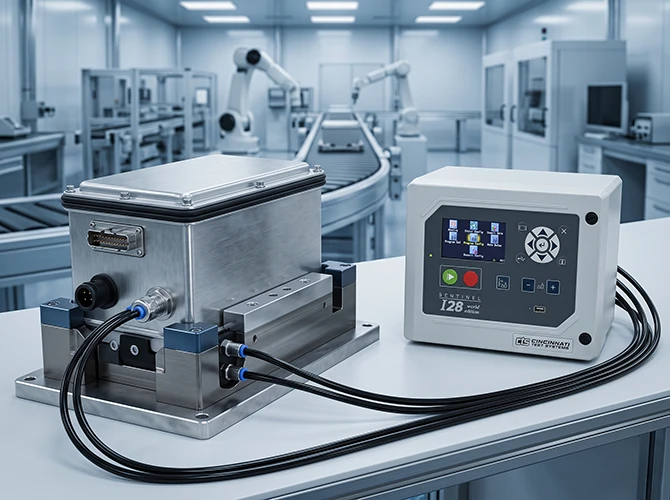
One-sentence answer: Robot battery compartments are mostly detachable structures, and leaks at the housing cover seal or connectors can cause water ingress and short circuits. With the CTS Sentinel I28 multi-function leak detector, pressure decay and differential pressure decay tests can be run sequentially (in-series) at the same station, covering both large-volume housings and small-volume connector cavities.
Compartment welds and connectors are the main leak paths, and a sealing failure directly affects battery safety
The housing has a large volume while the connector cavity is extremely small, placing different requirements on stabilization time and sensors; testing both with one set of parameters easily distorts results at both ends.
The compression varies with tightening torque and assembly sequence, and leaks mostly occur where the seal is locally not fully compressed.
Mobile and collaborative robots often operate in humid environments, and the enclosure protection must be verified according to the corresponding IP rating requirements of IEC 60529 / GB/T 4208.
Sealing locations: the seal between the housing cover and the housing, the mating surface between the quick-change connector and the housing, cable outlets, and thermal management interfaces (liquid-cooling quick couplings).Consequences of leakage: water ingress can cause short circuits in the battery and BMS and reduced insulation, with a risk of thermal runaway in severe cases; coolant leakage corrodes connectors; sealing failure limits the use of robots in washdown environments.
Why multiple methods in series are necessary here. The volumes of the housing and the connector cavity differ greatly, and their requirements for the test method are completely different: after the large-volume cavity is charged, pressure stabilizes slowly, making pressure decay suitable for giving an overall sealing conclusion; the connector cavity has a very small volume, and its pressure reading is extremely sensitive to temperature and clamping disturbances, so direct pressure testing is easily overwhelmed by environmental interference. Differential pressure decay is more suitable, comparing a reference part with the tested part and taking the differential pressure change. If one set of parameters is used to forcibly test both locations, the large-volume end may give unstable readings due to insufficient stabilization, while the small-volume end may mistake environmental drift for leakage, making both ends prone to distortion. Only by programming the two types of objects into different segments of the same instrument, each using a matching method and conditions, can the judgment be considered reliable. The compression of the housing cover seal also varies with tightening torque and assembly sequence, and leaks mostly occur where the seal is locally not fully compressed, so the assembly state must be included in the process specification.
Yes. The I28 runs different methods such as pressure decay and differential pressure decay in series within the same instrument. The housing uses the pressure decay stage, and the connector cavity uses the differential pressure decay stage. The two types of objects are judged separately and records are retained, without interfering with each other.
They will have an effect. It is recommended to include assembly torque and tightening sequence in the process specification and confirm they are in place before testing. At the same time, design support fixtures according to the profile to reduce reading fluctuations caused by differences in seal compression, making the conclusion more stable.
The complete machine's protection must be verified in the laboratory according to the corresponding IP rating of IEC 60529 / GB/T 4208; on the production line, air tightness testing is used as equivalent process control. Only by combining the two can sealing reliability and production takt time both be addressed.
The key is to separate the methods and conditions rather than share one set of parameters. The large-volume stage uses a stabilization time calibrated from actual measurements, and the small-volume stage uses differential pressure decay. Both are programmed into the sequence of the same instrument and completed in one clamping, saving transfer back and forth and secondary clamping. The overall takt time depends on the stabilization requirement of the large-volume stage.
The key point of robot battery compartments is to judge large-volume and small-volume objects separately. The multi-method sequential (in-series) capability and multiple program sets of the CTS Sentinel I28, together with dedicated fixtures for the housing, make it suitable for factory sealing inspection of battery compartments for mobile and collaborative robots.

WeChat for technical support

PLUS Douyin
