AI Server Liquid Cooling System Sealing Test: Pain Points and Solutions

PLUS (Guangzhou) Intelligent Technology Co., Ltd. | Making Every Liquid-Cooled Server Withstand the Sealing Test
AI server liquid cooling system sealing test Cold plate air tightness testing CDU Sealing Verification Quick connector sealing life test Nitrogen-hydrogen tracer leak detection Hydrogen mass spectrometry testing
01

I. Background: The AI Computing Power Explosion Makes Liquid Cooling a Necessity

In 2025, global AI server output value exceeded USD 400 billion, up 45% year on year. The NVIDIA Blackwell GB200 has a single-GPU power consumption of 1200W, and the power consumption of a complete rack exceeds 120kW—traditional air cooling can no longer meet the heat dissipation requirements.

The penetration rate of liquid cooling solutions climbed rapidly from 14% in 2024 to over 30% in 2026. Cold plate liquid cooling has become the mainstream choice (with a market share of approximately 65%), while immersion liquid cooling is being deployed at an accelerating pace in high-density scenarios.

Key components involved in liquid cooling systems —Cold Plate, CDU (Coolant Distribution Unit), Manifold, Quick Connect, Cooling LinesEvery component's sealing reliability directly determines the safety and service life of the data center.

02

II. Core Pain Points of Liquid Cooling Sealing

Pain point 1Coolant Leak = Catastrophic Disaster for IT Equipment

The internal circulation of a liquid cooling system uses deionized water, glycol solution, or fluorinated liquid. Once the seal fails:

  • Conductive coolant leak→ Server short circuit → A single failure can cause losses of millions of yuan
  • Microchannel leaks in liquid cooling plates (at the 0.1 mL/min level) are difficult to detect with traditional water immersion testing.
  • A financial data center experienced a server short circuit caused by coolant degradation, resulting in a single-incident loss exceeding 3 million yuan.
Industry requirement: The CDU sealing test threshold must reach10⁻⁵ ~ 10⁻⁷ mbar·L/sLevel.

Pain Point 2Many welds/joints, hidden leak points

A single liquid cooling system contains dozens of potential leak points:

ComponentsTypical leak pointsQuantity/unit
Cold plateBrazed/friction stir weld seams, inlet and outlet joints2 to 6 locations
CDUHeat exchanger welds, pump seals, valve bodies, sensor interfaces20+ locations
ManifoldDistributor weld points, quick connectors10 to 30 locations
Quick connectorO-ring seal, plug-in end face1 pair per GPU
Cooling linePipe fittings and elbow weldingDozens of locations

Every joint, weld seam, and sealing ring is a potential leak path.

Pain point 3Compatibility Challenges of Fluorinated Fluids/Coolants with Sealing Materials

  • Some ABS plastic seals exhibited swelling and deformation after being immersed in fluorinated fluid for 6 months.
  • Long-term coolant circulation may produce acidic degradation products that corrode sealing surfaces.
  • Accelerated aging of rubber seals under high-temperature conditions (130°C aging test)

Pain point 4Traditional leak detection methods are falling short.

MethodLimitations
Water immersion bubble testLow sensitivity, unable to detect微小 leaks; risk of water residue
Pressure decay methodTemperature-sensitive; insufficient detection accuracy for large-volume CDUs; unable to locate leak points
Vacuum methodNot suitable for assemblies with precision electronic components or soft plastic housings.

Pain point 5The conflict between production line takt time and testing accuracy

Mass production requires fast, highly reliable leak detection solutions, while traditional methods are either slow, inaccurate, or only capable of qualitative assessment without locating leaks. Cold plate manufacturers require 100% inline leak detection, but the inspection time available for each product on the production line is limited.

03

III. PLUS Solutions: Full Coverage from Air Sealing Test to Hydrogen Detection

PLUS (Guangzhou) Intelligent Technology has focused on the sealing test field for over 8 years and is a national high-tech enterprise (+ CE certification + ISO certification). Its product line covers the full chain from conventional air tightness testing to high-precision tracer gas leak detection, fully matching the sealing test requirements of every stage of AI server liquid cooling systems.

Option 1Cold plate / liquid cooling plate air tightness testing

Recommended equipment: X530 High-Precision Differential Pressure Leak Detector / D530 High-Precision Direct Pressure Leak Detector

  • 24-bit high-precision sampling— Sensitively captures minute pressure changes, leaving no micro-leak undetected
  • Differential pressure range ±500~±5000 Pa— Compatible with different cold plate design requirements
  • 99 parameter sets— Rapid changeover between multiple cold plate models, supporting flexible line changeovers
  • 8 IN / 8 OUT IO interface + RS232/TCP/IP— Seamless integration with automated production lines for 100% inline leak testing
  • Optional electrically controlled pressure regulating valve, automatically adjusts test pressure

Suitable for:Copper alloy cold plate, aluminum alloy cold plate, microchannel cold plate, vacuum brazed cold plate, friction stir welded cold plate
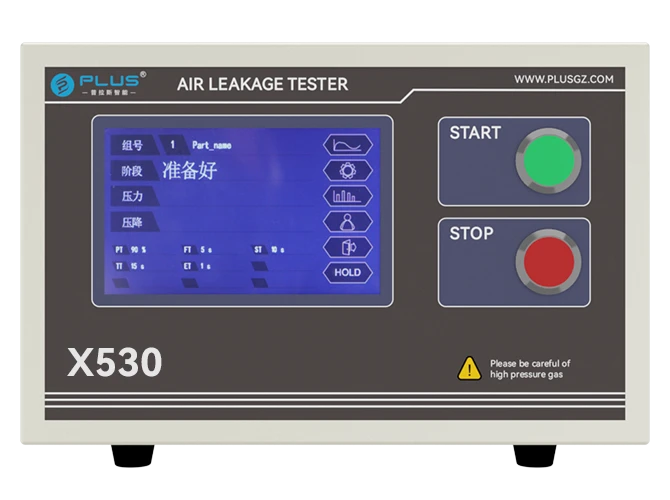
X530 高精度差压检漏仪
X530 High-Precision Differential Pressure Leak Detector

The current page is organized by topic, and the product image positions in the original text have been reserved as equipment display slots.

Customer value:Before leaving the factory, 100% air tightness testing is performed on cold plates to ensure no micropores in welds and no leaks at joints, preventing coolant from seeping into server chassis.

Option 2CDU (Coolant Distribution Unit) Finished Product Sealing Verification

Recommended equipment: PLUS Nitrogen-Hydrogen Tracer Leak Detector / P520 High-Precision Flow Tester

P520 高精度流量仪
P520 High-Precision Flow Tester

Keep the original equipment image placement on the page for corresponding product display and future asset replacement.

The CDU is the "heart" of a liquid cooling system, containing dozens of potential leak points such as heat exchangers, pumps, valves, and sensor interfaces.Require full-machine verification after all components are assembled.。

Option A — Nitrogen-Hydrogen Tracer Leak Detection (Recommended)

  • Use a 5% H₂ + 95% N₂ gas mixture (forming gas, safe and non-flammable)
  • After filling the CDU system, scan along the welds, joints, and sealing surfaces with a sniffer probe.
  • Precisely locate the leak point, on-site repair + retest
  • Sensitivity up to 10⁻⁵ ~ 10⁻⁷ mbar·L/s, meeting industry standards
  • Not affected by temperature/humidity,Dry, non-corrosive, residue-free

Option B — Quantitative Flow Testing

  • P520 flow tester accuracy ±0.8% of reading ±0.2% of full scale
  • Selection range: 0.5~200 sccm / 500 sccm / 1~1500 SLPM
  • Quantitative leak rate data output, capable of integrating with MES systems
Customer value:It not only provides a qualitative judgment of "leaking or not leaking" but also delivers quantitative data on "how much is leaking." At the same time, tracer gas sniffing precisely locates the leak point, greatly improving the first-time repair pass rate.

Option 3Quick connector sealing life test

Recommended equipment: P530 Flow Tester

Quick connectors are required to maintain zero leakage after thousands of insertion and removal cycles. Utilizing the P530's999 sets of extra-large parameter groups, yes:

  • Set multiple test parameter groups for before/after insertion and removal.
  • Record the leak rate data for each test.
  • Track the sealing performance decay curve
  • Set a fail threshold for automatic alarm

Option 4Immersion liquid cooling tank / sealed enclosure leak detection

Recommended equipment: MT100 multi-station tester / X730 integrated leak detector

  • MT100 supports 1 to 4 stations, with automatic pressure regulation (up to 4 MPa)
  • X730 Built-in Sealing Fixture + Dynamic Pressure Curve + 20,000 Historical Records
  • Dedicated Solution for Sealing Testing of Large-Volume Cavities

Plan 5Cooling line/connector sealing test

Recommended equipment: D530 direct pressure leak detector

  • Quickly seal both ends of the pipeline, then pressurize with air and monitor the pressure decay.
  • Paired with PLUS's ownQuick sealing connector(external card sleeve type / internal expansion jaw type / pneumatic internal expansion type), compatible with different pipe diameters
  • The single-piece test cycle can be controlled within 15–30 seconds, making it suitable for high-volume production lines.
04

IV. Hydrogen Detection: PLUS's Core Differentiating Capability

PLUS has deep expertise in hydrogen detection:

YearMilestones
2020Launch hydrogen leak testing equipment
2021Hydrogen fuel cell bipolar plate sealing test equipment delivered
2024Launch helium mass spectrometer leak detection equipment
2025Launch hydrogen mass spectrometer testing equipment

In liquid cooling scenarios,Hydrogen-nitrogen tracer leak detectionCompared with helium leak testing, it offers three core advantages:

  1. Cost advantage— 5% H₂ + 95% N₂ gas mixture costs far less than helium, eliminating the need for a helium supply chain
  2. Safe and reliable- 5% hydrogen is well below the lower flammability limit (4% LFL), making it safe and non-flammable
  3. Comparable accuracy— Hydrogen has the smallest molecular weight, and its tracer sensitivity is no less than that of helium.
PLUS is one of the few companies that simultaneously mastersAir pressure leak detection, flow leak detection, nitrogen-hydrogen tracer leak detection, helium mass spectrometer leak detection, hydrogen mass spectrometer leak detectionDomestic manufacturers of five technology routes.
05

V. Why Choose PLUS

Since 2018, PLUS has been deeply engaged in sealing testing, serving multiple industries including new energy, automotive, and consumer electronics, and has extended its proven capabilities to sealing test applications for AI server liquid cooling systems.

8 years of focus on sealing tests

  • From 2018 to the present, we have focused on one thing only—sealing test.
  • We have accumulated experience with hundreds of solutions in the new energy, automotive, and consumer electronics industries.
  • Liquid cooling circuit testing is simply an extension of our existing capabilities.

Full product line, one-stop procurement

  • From differential pressure leak detection to direct pressure leak detection, from flow leak detection to tracer gas leak detection.
  • From helium mass spectrometry to hydrogen mass spectrometry — customers don't need to look for multiple suppliers; PLUS covers it all.

Liquid cooling case studies

  • Radiator Sealing and Vacuum Filling System: Integrated Hydrogen-Nitrogen Sealing Test + Vacuum Filling
  • Hydrogen fuel cell plate sealing test: 100% inspection of bipolar plate sealing performance, meeting the highest standards of the hydrogen energy industry
  • Cooling line sealing test: air tightness testing for power battery thermal management liquid cooling lines
  • Water Pump Helium Testing Equipment: Helium Testing for Thermal Management Systems

Complete qualifications

  • High-Tech Enterprise(Recognized by the Ministry of Science and Technology of China)
  • CE Certification(Certificate No.: M.2024.206.C99088, LVD+EMC)
  • ISO certification(Chinese and English bilingual version)
  • 15 utility model patents + 3 software copyrights

Custom-engineered solutions + full-line delivery

  • From standalone units to complete lines, from manual to fully automated
  • Supports barcode scanning for MES binding, data traceability, fixture control, and automatic sorting
  • Multiple complete-line projects delivered (3 test systems + fixtures + data acquisition)
06

VI. Target Customer Profile

Customer TypeApplication Scenarios
Cold plate manufacturer100% air tightness testing at the factory, integrated into mass production lines
CDU assembly plantComplete machine helium leak testing / nitrogen-hydrogen tracer testing, precisely locating leak points
Liquid cooling system integratorIncoming inspection of components + full-system verification
Server OEMLiquid cooling plate / quick connector incoming material sealing verification
Data center operatorsCDU pre-installation acceptance test, in-service leak inspection
Immersion liquid cooling manufacturersSealed enclosure air tightness + pipeline sealing test
07

VII. Summary

AI server liquid cooling is not an optional luxury feature, but a necessity in the Blackwell/Rubin era.

The sealing reliability of a liquid cooling system is not "one of" the quality metrics—it is the bottom line.

One leak = server destruction + data loss + days of downtime.

PLUS with8 years of deep cultivation in the sealing test field、Full-category leak detection product line、Nitrogen-hydrogen tracer and hydrogen mass spectrometry unique capabilities, providing one-stop sealing test solutions for the liquid cooling industry, from components to complete systems, from production lines to on-site, and from air to hydrogen.

08

Contact Us

Official Website
www.plusgz.com
Phone
400 999 0513
Email
info@plusgz.com
Address
3rd Floor, Building A1, No. 36 Xinhe North Road, Zengcheng National Development Zone, Guangzhou
Copyright © 2026 PLUS (Guangzhou) Intelligent Technology Co., Ltd. All rights reserved. 粤ICP备2023022749号
Enquiry

verification code